
The best CNC router for most Canadian small shops, classrooms, and makers in 2026 is a single-phase, small-format machine with a 3HP spindle and a 24″ x 48″ or 48″ x 48″ bed. Plan to invest an amount that scales with bed size and spindle power (see current pricing on each product page) for a machine that runs daily without needing three-phase power, dedicated shop space, or a service contract just to keep it humming. The most common mistake we see new buyers make is over-spec’ing the first machine and ending up with one they can’t run on the power they already have. This guide walks through what to look for, what to spend, and which models actually deliver for the work most Canadian small shops, makerspaces, and schools do.
Who This Guide Is For
Small Canadian shops doing custom or production work with one to five people on the floor. Cabinet shops finding their footing, sign shops scaling up, custom millwork operations, makerspaces with commercial work, prototyping shops, and schools running CNC programs. If you’re cutting fewer than three sheets per week and your work is one-off, an enclosed desktop ACADEMY or DISCOVERY 1/2 is likely enough. If you’re cutting more than twenty sheets weekly and need a full 4’x8′ bed, you’re past what most small-format machines are built for and that’s a different conversation.
What to Look For in a Small-Format CNC Router
Five specs matter more than anything else when you’re shopping for your first or second small-format CNC.
Bed Size
Match the bed to the work, not to a generic industry standard. A 12″ x 12″ DISCOVERY 1 or ACADEMY 1 is a good fit for classroom signage, jewellery, small parts, and engraving. A 24″ x 48″ SIMPLY 8 or PERFORMANCE 8 handles most sign work and smaller cabinet components. A 48″ x 48″ PERFORMANCE 16 or DISCOVERY 16 is the right pick when you’re working on larger panels regularly. Simply Technologies’ small-format CNC lineup tops out at 48″ x 48″. If your work consistently needs a full 4’x8′ sheet uncut, that’s a different machine class.
Spindle Power and Cooling
For wood, plywood, MDF, acrylic, plastics, and light aluminum work in a small shop, a 3HP water-cooled spindle handles the vast majority of jobs. Smaller desktop and classroom machines (DISCOVERY 1/2, ACADEMY 1/2) run a 1HP air-cooled spindle, which is the right call at that scale and avoids the extra water-cooling infrastructure. Water-cooled spindles run quieter and last longer under daily production. Air-cooled spindles are simpler and lighter for classroom or maker use. Both are fine when matched to the right work.
Controller and Workflow
Simply Technologies runs two controller platforms across the CNC lineup. The eCNC with a 7″ touchscreen sits on the DISCOVERY 1/2/8/16 series and is built for clean, hands-on operation. The iCNC with a 15.6″ touchscreen sits on the PERFORMANCE series and the DISCOVERY 16ATC, with wireless file transfer, real-time toolpath display, and remote operation from an Android device. If you’re moving files around a shop or running multiple operators, the iCNC tends to earn its keep. If it’s a single operator in one spot, the eCNC keeps it simple.
Power and Shop Setup
This matters more than most buyers realize, and it’s where bad advice does the most damage. Every CNC in our small-format lineup runs on standard single-phase power. The DISCOVERY 1 and 2 run on 110V (15A) or optional 220V. The DISCOVERY 8/16 and the entire PERFORMANCE series run on 220V single-phase at 10A. No three-phase. No panel upgrades. No 200-amp service required. That’s the whole point of a small-format CNC: it goes in the shop you already have.
Software
VCarve Pro from Vectric is the most common CAM software for production woodworking, sign making, and custom millwork on our CNC lineup. Aspire adds full 3D modelling for shops doing decorative or sculptural work. VCarve Desktop is a lower-tier option for hobby and classroom use with a smaller job-size ceiling. You can buy the software as a standalone licence or add it to your CNC order. Training is available as an add-on package when your team needs to get up to speed faster.
How Much Should a Small-Format CNC Cost in Canada?
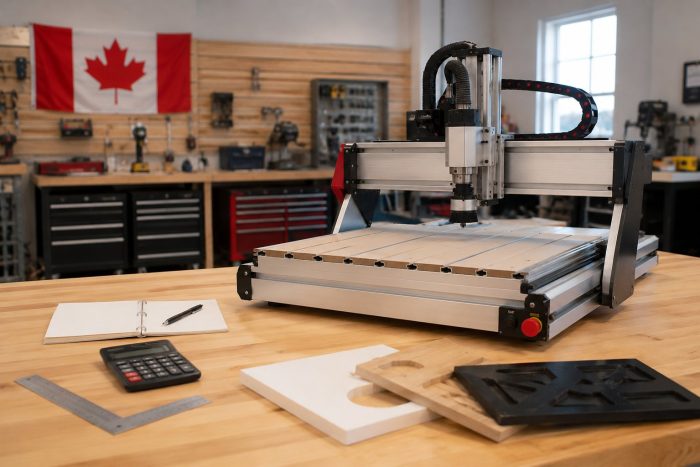
See current pricing for small-format CNC routers on each product page; the site displays prices in your local currency based on your location. Prices on the site do not include freight; a quote will include freight to your shop and any applicable duty.
Classroom, maker, and desktop CNC: the entry tier (DISCOVERY 1, DISCOVERY 2, ACADEMY 1, ACADEMY 2). Right pick for schools, makerspaces, jewellery shops, signage detailing, and prototyping.
Entry small-shop production CNC: a modest step up from entry (SIMPLY 4, SIMPLY 8, DISCOVERY 8). Right pick for sign shops getting started, custom builders, and shops moving past manual fabrication.
Daily-production small-format CNC: the mid-range investment tier (PERFORMANCE 6, PERFORMANCE 8, PERFORMANCE 8W, PERFORMANCE 16, DISCOVERY 16, DISCOVERY 16ATC). The sweet spot for daily Canadian small-shop work.
Flagship small-format CNC with automatic tool changer: the top investment tier (PERFORMANCE 8ATC and PERFORMANCE 16ATC). Right pick when you’re running multi-bit production daily and want automatic tool changes to free up operator time.
These prices cover the base machine. Optional add-ons (dust shoes, vacuum hold-down, training packages, software bundles, accessory packages) are itemized on each product page and can be combined into a single quote. If you’re comparing currencies, get a written quote rather than estimating from an exchange rate.
Five Small-Format CNC Routers Worth Looking At in 2026
Based on what runs reliably in Canadian shops, classrooms, and makerspaces, and what stays running for years after the install.
1. PERFORMANCE 8 (24″ x 48″) — Most Recommended for Small Shops
Part of the PERFORMANCE Series, which includes six configurations from 24″ × 36″ to 48″ × 48″ ATC.
See current pricing on the product page. One of the most practical fits for many small shops. 24″ x 48″ bed, 3HP water-cooled spindle, iCNC 15.6″ touchscreen with wireless file transfer, single-phase 220V. Built for daily small-shop production without being overbuilt for a one-to-three-person operation. Cuts wood, plywood, plastics, composites, foam, aluminum, and non-ferrous metals cleanly.
Best for: Sign shops doing daily production, custom builders, cabinet shops handling smaller cabinet components, makerspaces with commercial work.
2. SIMPLY 8 (24″ x 48″) — Entry Production CNC
See current pricing on the product page. The compact, lower-cost entry into 24″ x 48″ production. 3HP air-cooled spindle, eCNC 7″ touchscreen, single-phase. Right pick when budget is the constraint or shop space is tight but you still need a real production bed.
Best for: Smaller custom shops, prototyping, makerspaces with light commercial work, schools running an applied program.
3. PERFORMANCE 16 and 16ATC (48″ x 48″) — Larger Bed Production
See all six configurations, including the 16ATC with automatic tool changer, on the PERFORMANCE Series page.
Available in two configurations, with and without an automatic tool changer. Full 48″ x 48″ bed, 3HP water-cooled spindle, iCNC controller, single-phase 220V, welded steel frame included. The right pick when you’re working on larger panels regularly and want a machine that scales with the work without needing a three-phase shop upgrade.
Best for: Cabinet shops working at panel scale, sign shops doing larger formats, custom builders running multi-bit jobs (16ATC).
4. ACADEMY 1 or ACADEMY 2 — Enclosed Classroom CNC
See current pricing on the product page (ACADEMY 1, 12″ x 12″) or (ACADEMY 2, 24” x 12″ floor model). Enclosed desktop or floor-model CNC built specifically for education environments. Safety enclosure, eCNC controller, optimized for student operators learning the workflow. Pairs with our EMPOWER[ED] ACADEMY CAD and CNC certification program, which is one of the things that separates our education offer from the rest of the market. More on that further down.
Best for: Schools, training programs, after-school maker programs, technical education classrooms.
5. DISCOVERY 1 (12″ x 12″) — Desktop and Maker
The DISCOVERY Series runs from the compact 12″ × 12″ DISCOVERY 1 through the 48″ × 48″ DISCOVERY 16ATC. Five models total.
See current pricing on the product page. Compact 12″ x 12″ desktop CNC with a 1HP air-cooled spindle and the eCNC 7″ touchscreen. Designed for makers, jewellery shops, classroom labs, and small project work where space is the constraint. 110V single-phase, so it runs from a standard outlet. Plenty of our customers use a DISCOVERY 1 as a home-shop machine, and it’s built to keep running well past its first year of weekend projects.
Best for: Home shops, makerspaces, jewellery and small craft production, classroom labs, anyone learning CNC for the first time.
Common Mistakes Small Shops Make Buying Their First CNC
These are the patterns we see most often. Avoid these and you’ll buy once.
Over-spec’ing the first machine.
The instinct is to go big so you don’t outgrow the machine. In the small-format world, this usually means buying more bed and more spindle than the actual work needs, paying for power you can’t run on the shop’s existing service, and ending up with a machine that sits more than it should. Match the bed and spindle to the work you actually do today, with one tier of headroom, and you’ll be in good shape.
Skipping software and a real workflow.
The CNC is half the system. The CAM software (VCarve Pro, Aspire, Fusion 360) is the other half. Buy the machine without a software workflow and operators who know how to use it, and you’ve bought an expensive paperweight for the first month. Add the software to the order, and if your team is new to CNC, add a training package so the learning curve doesn’t kill your first quarter.
Underestimating dust collection.
CNCs produce a lot of fine dust. Without proper collection, you’re creating a fire hazard, a health hazard, and shortening machine life. Plan dust collection into the budget. Add a dust shoe at minimum and a properly-sized collector for daily use.
Importing direct from overseas.
On paper, importing direct can look cheaper. In practice, once you add customs, brokerage, freight, time spent troubleshooting, and the lack of a real warranty when something breaks, the math usually flips. Buying through a North American CNC supplier that operates and ships from London, Ontario is a cleaner path for Canadian buyers most of the time.
Forgetting the shop fits the machine, not the other way around.
Measure the door. Measure the available floor space. Confirm your electrical. Tell us the truth about your shop before we recommend a machine. We have customers running everything from a DISCOVERY 1 on a desktop to a PERFORMANCE 16ATC in a dedicated production bay. The right answer depends on where the machine is going to live.
A Note on Education: EMPOWER[ED] ACADEMY
If you’re buying for a school, this section matters more than the spec sheet. EMPOWER[ED] ACADEMY is our CAD and CNC certification program built specifically for K-12 and post-secondary classrooms. If you are planning the room itself, our guide to setting up a CNC lab or makerspace in your school covers space, power, and dust. It includes a structured curriculum mapped to industry-standard CAD and CNC workflows (see the full CAD and CNC curriculum for schools), teacher onboarding so the instructor isn’t left to figure it out alone, teacher certification built into the training, and the kind of long-term classroom continuity that means the program is still running well after the first cohort graduates. Most CNC sellers stop at the machine. EMPOWER[ED] ACADEMY is one of the reasons school districts that buy from us tend to expand the program in year two.
Where to Buy a Small-Format CNC in Canada
A few paths exist: import direct from overseas, buy from a US-based seller, or buy from a North American CNC company like Simply Technologies. Our CNC lineup is manufactured by our partners in Taiwan and assembled, supported, and shipped from our London, Ontario facility across Canada and the US. About seventy percent of our business is in the US, with the balance across Canada, which means our shipping, support, and warranty processes are built to handle both sides of the border cleanly.
On-site install and training are available as optional packages when your team needs them, and most remote support issues can be resolved quickly through phone or email. CNC parts and accessories ship from our London warehouse. If you want to talk through what makes sense for your shop, get in touch.
Frequently Asked Questions
What’s the cheapest CNC router worth buying for a small shop or classroom in Canada?
The DISCOVERY 1 is the most accessible 12″ x 12″ desktop CNC in the lineup, with a 1HP spindle and eCNC controller. For a classroom with an enclosed machine, the ACADEMY 1 adds the safety enclosure at a modest step up. Below that, you’re in hobby-grade territory built to a different standard. The site displays pricing in your local currency.
Can I finance a CNC as a Canadian small business?
Yes. Most Canadian buyers finance through bank business loans, equipment leases, BDC equipment financing, or third-party equipment finance partners. Monthly payments on a typical small-format CNC usually run in the low hundreds depending on machine tier, term, and structure. Talk to your accountant about capital cost allowance treatment for the purchase year.
How long does it take to learn to run a small-format CNC?
Most operators are running basic production within two days of focused hands-on training. The software (VCarve Pro most commonly) is usually the bigger learning curve than the machine itself. Training packages are available as an add-on. For schools, EMPOWER[ED] ACADEMY gives teachers a structured CAD and CNC certification path, with onboarding built in so the program runs independently in the classroom.
What’s better for a small shop: a small-format CNC or a CO2 laser?
They do different work. CNC routers handle thicker material, panel cutting, and 3D milling. CO2 lasers handle fine detail, engraving, and clean edges on acrylic and thin wood. Most small shops start with whichever matches their primary product and add the other as the work expands. Sign shops often run both: CNC for structural panels, laser for detail and acrylic.
Do I need three-phase power for a small-format CNC in Canada?
No. Every small-format CNC in our lineup runs on standard single-phase: 110V on the smaller desktop and classroom models, 220V single-phase at 10A on the larger production models. You don’t need a panel upgrade or three-phase service to run any of these machines.
How much shop space do I need for a small-format CNC?
A DISCOVERY 1 fits on a sturdy workbench. A 24″ x 48″ PERFORMANCE 8 fits in roughly 8 by 6 feet of floor space with working room around it. A 48″ x 48″ PERFORMANCE 16 wants about 10 by 9 feet. Add space for dust collection, a computer or tablet station, and material staging. Measure before you order.
Does Simply Technologies ship across Canada?
Yes. We ship across all provinces from our London, Ontario warehouse. We also ship across the US, which is where the majority of our business sits today. Remote support and software help are typically handled quickly through phone or email.
What software is best for a small Canadian CNC shop?
VCarve Pro is the most common pick for production woodworking, sign making, and custom millwork. For more complex 3D or mixed-material work, Aspire adds the modelling layer. VCarve Desktop is a lower-cost option for hobby and classroom use with a smaller job-size ceiling. We sell all three and can match the software to your workflow when you order the machine.