
Bringing real manufacturing capability into a small shop, classroom, or startup doesn’t require three-phase power or a massive facility anymore. Small production CNC machines—compact routers and mills built for daily use—have changed how the small guy approaches in-house machining. This guide breaks down what defines a true small production CNC, how to evaluate core features, and why scalable systems matter when you’re planning for growth.
Key Takeaways
- A small production CNC machine is a compact, single-phase router or mill designed for real parts output in small shops, schools, and startups—not just hobby projects on weekends.
- Modern small CNC routers from Simply Technologies (SIMPLY, DISCOVERY, PERFORMANCE series) can run continuous production work in wood, plastics, and non-ferrous metals like aluminum on standard 120–240 V single-phase power.
- A scalable product structure (SIMPLY → DISCOVERY → PERFORMANCE → PERFORMANCE ATC) lets users start small and grow into higher throughput and automation without replacing their entire workflow.
- Support, training, and safety features—including CSA-compliant systems, structured education programs, and phone-based guidance—are critical when evaluating equipment for a small production environment.
- Simply Technologies positions itself as a CNC-first provider, with CO₂ lasers and shop automation as add-ons that expand capacity without adding operational complexity.
What Is a Small Production CNC Machine?
A small production CNC machine is a compact, computer-controlled router or mill built for continuous use in small shops, classrooms, and startup environments. These systems differ from hobby-grade equipment in one fundamental way: they’re engineered for real, repeatable part output rather than occasional weekend projects.
“Small production” means short runs, batches, and on-demand manufacturing of actual components—fixtures, enclosures, jigs, and panels—day after day. The machine holds tolerance, runs the same program reliably, and doesn’t require constant maintenance or improvisation.
What makes these systems practical for constrained spaces is their power requirements. Most run on standard single-phase electricity (120 V or 240 V) instead of three-phase industrial service, making them viable for garages, leased commercial units, and school facilities without expensive electrical upgrades.
Typical working envelopes range from 2’×3’ benchtop units to 4’×4’ or 4’×8’ gantry-style routers. This article focuses primarily on CNC routers, aligning with Simply Technologies’ CNC product lineup. These machines process wood, plastics, composites, and aluminum with the precision and consistency that hobby equipment simply cannot match.
Why Small Shops and Startups Choose Compact CNC Systems
In 2024–2026, the landscape looks familiar: product startups iterating prototypes, Etsy makers scaling to batch production, prototype labs testing designs, and vocational programs teaching manufacturing skills. All of them face the same question—outsource machining or bring it in-house?
Here’s why compact CNC systems win:
- Cost control versus outsourcing: Owning a small CNC router lets you iterate designs without waiting on external quotes. Shops report cutting outsourcing costs by 50–80% on lead times while retaining intellectual property on custom parts like phenolic fixtures, HDPE enclosures, and aluminum panels. Better cash flow follows when you’re not financing someone else’s production schedule.
- Footprint and facility constraints: Many small manufacturers work in under 1,000 square feet. A compact CNC on single-phase power avoids the whole lot of expensive electrical upgrades that three-phase service demands. A benchtop model might occupy 25×30 inches; larger gantry routers fit 50×50 inches.
- Faster design-to-part cycles: Going from a CAD file to a finished part in hours—instead of days or weeks waiting on suppliers—changes how you approach prototyping. Engineers can test, modify, and recut the same day.
- Material flexibility: Small CNC routers process plywood, MDF, phenolic, HDPE, aluminum plates, and composite panels. That range covers signage, fixtures, product housings, and jigs without specialized tooling for each.
- Education and training value: Schools and makerspaces choose compact CNC systems to give students hands-on experience with industry-relevant CAD/CAM workflows. Graduates leave with knowledge directly applicable to modern manufacturing jobs.
Core Features to Look For in a Small Production CNC Machine
Evaluating a small production CNC requires looking beyond spec sheets. What matters is performance in real workflows—daily use, repeatable tolerances, and minimal downtime.
Rigidity and construction: Look for welded steel frames, linear guides, and quality ball screws. Aluminum extrusion frames work for hobby machines but flex under production loads. Steel maintains repeatability at tolerances down to 0.001 inches. Forum discussions consistently note that ball screws outperform leadscrews, keeping backlash under 0.005 inches.
Control system and software: An industrial-style controller should handle standard G-code reliably, with consistent homing and probing routines. Compatibility with common CAM software—Fusion 360, VCarve, SolidWorks-CAM—matters because your operators shouldn’t need to learn a proprietary code ecosystem.
Single-phase power: For most small shops and classrooms, 120–240 V single-phase capability is essential. This mirrors the electrical service in a typical house, garage, or leased commercial space. Three-phase remains unnecessary for 90% of small production work in non-ferrous materials.
Workholding and fixturing: Production-oriented CNC machines should support threaded tables, vacuum zones, and repeatable fixture plates. When you’re running 100 identical parts, setup time matters. A versatile table system lets you fix workpieces quickly and repeatably.
Safety systems: E-stops, guarded moving components, proper dust extraction provisions, and—for education environments and Canadian customers—CSA-compliant designs. Industry data suggests inadequate dust extraction causes 20–30% of bearing failures in real shop environments.
Serviceability and parts availability: In small production, downtime costs money. Being able to source replacement components (standard NEMA motors, common bearings) and perform basic service in-house keeps machines running.
Simply Technologies CNC Lineup for Small Production
Simply Technologies builds CNC routers and systems for small production shops, schools, and maker spaces. The CNC product lineup follows a logical progression that lets users scale without starting over.
- SIMPLY series: The entry point—compact footprint, single-phase power, ideal for a first CNC in a startup or classroom. These machines handle wood, plastics, and light aluminum jobs, giving users access to real production capabilities without industrial infrastructure.
- DISCOVERY series: A step up with a larger work area and heavier construction. Job shops and prototyping labs choose DISCOVERY for higher throughput and more demanding materials. The additional rigidity supports longer production runs.
- PERFORMANCE series: Higher-duty components, faster rapids, and better precision for continuous production work. This is where shops cutting fixtures, panels, and production batches find their capabilities matched to volume demands.
- PERFORMANCE ATC: The automatic tool changer option reduces setup time by roughly 50% on multi-tool jobs. Shops running repeat programs with different kinds of tooling save hours per week. The process stays straightforward—same control system, same programming approach.
The model progression means you can start on a SIMPLY system and move up to DISCOVERY or PERFORMANCE machines while retaining workflows and training investments. Operators don’t need to relearn fundamentals; they scale their skills alongside the equipment.
Explore specific machine configurations to compare envelope size, spindle power, and target applications.
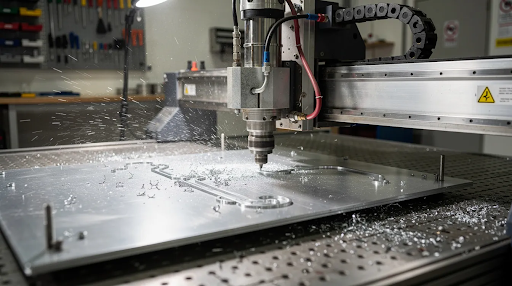
Scalable Growth: From First CNC to Small Production Cell
Most users don’t start with a full production cell. They begin with a single small CNC machine and grow into multiple machines or mixed CNC/laser workflows over 1–3 years.
A typical growth path looks like this:
- Year one: A SIMPLY machine handles prototypes, jigs, and early customer orders. The shop learns CAM workflows and establishes repeatable processes.
- Years two and three: Production volume increases. Adding a DISCOVERY or PERFORMANCE machine handles higher throughput while the original SIMPLY continues supporting prototyping and short runs.
- ATC integration: As throughput demands rise, an automatic tool changer reduces manual tool changes on repeat jobs. What used to require operator intervention every few minutes now runs unattended.
- Accessory upgrades: Dust collection, vacuum tables, and rotary axes expand capability without changing core workflows. These aren’t replacements—they’re enhancements to existing systems.
CO₂ laser systems from Simply Technologies complement CNC routers for engraving, thin-material cutting, and labeling. A small manufacturer might run structural machining on the CNC and add laser-cut graphics or identification marks—different types of operations sharing the same production cell.
Imagine a small manufacturer moving from prototyping enclosures to sell hundreds of units per month. Two CNC machines handle different sizes of work while a CO₂ laser adds branding and serial numbers. That’s scalable growth without starting from scratch.
Education and Training: Making Small Production CNC Work in Classrooms
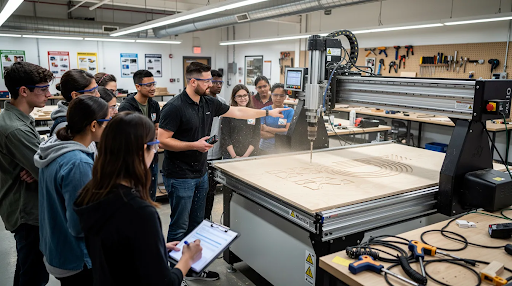
Many “small production” environments are actually schools and training centers manufacturing fixtures, student projects, and teaching aids at scale. The equipment needs to be reliable, safe, and teachable.
- ACADEMY Series: Simply Technologies’ ACADEMY Series pairs CNC hardware with a 16-session curriculum covering CAD, CAM, and machine operation. Students learn the software, the control systems, and the safety procedures in a structured program—not through trial and error.
- EMPOWER[ED] ACADEMY: Certification pathways ensure students can operate small production CNC machinery safely and repeatably. Graduates leave with documented skills that employers recognize.
- Teacher onboarding: Instructors receive support, lesson plans, and implementation guidance. This isn’t equipment dropped at the door with a manual—it’s a system designed to succeed in classroom environments.
- Safety and compliance: CSA-compliant systems for Canadian schools, lockable enclosures, appropriate interlocks, and clear operating procedures. Forums note that 10–15% scrap rates from operator errors drop significantly with proper training programs.
Students learning on these small production CNC machines graduate with skills directly applicable in manufacturing shops. The control systems, tooling, and workflows mirror what they’ll encounter in the world outside the classroom.
Support, Reliability, and Real-World Implementation
Small production success depends on support and guidance as much as hardware specifications. A cheaper machine with no backup becomes expensive when it’s down for weeks.
- Pre-sales consultation: Simply Technologies offers phone-based consultations (call 800-288-2961) to match machine capabilities to actual parts and workloads. This isn’t a business that sells boxes—it’s one that helps you create the right production setup.
- Ongoing support: Troubleshooting, parts sourcing, and setup optimization continue after purchase. Remote assistance for CAM posts and workholding strategies means you’re not guessing at solutions when something doesn’t sound right.
- Built for real shops: Machines and accessories are selected for long-term reliability in dusty, real-world shop environments. Components handle the stuff that accumulates when you’re cutting MDF and aluminum daily—chips, dust, and vibration.
- Consistent control systems: Having standardized components across the SIMPLY, DISCOVERY, and PERFORMANCE lines simplifies training and maintenance. Operators don’t need to fix different problems on every machine; they learn one ecosystem.
If you’re evaluating equipment for small production, a conversation helps more than a spec sheet. Call 800-288-2961 or visit the CNC products page to discuss your specific applications.
FAQ
How much does a small production CNC machine typically cost?
Entry-level SIMPLY-class CNC routers suitable for real production work generally start in the mid-four-figure to low-five-figure USD range, depending on size and options. DISCOVERY and PERFORMANCE series machines, with larger envelopes and heavier construction, move into higher five-figure ranges once tooling, dust collection, and fixturing are included.
Total “ready to run” budgets should account for CAM software, tooling, workholding, and basic training time—typically adding 20–30% to base machine price. ROI calculations show breakeven in 6–12 months for shops producing 100–500 parts monthly. Contact Simply Technologies directly for current pricing and configuration guidance tailored to your parts and materials.
Can a small CNC router really replace outsourced machining for my startup?
For startups producing parts in wood, plastics, composites, and non-ferrous metals like aluminum, a compact CNC router handles both prototyping and production batches in-house. You control lead times, protect IP, and save money on iterative design cycles.
For complex 5-axis metal parts or heavy steel, outsourcing may still make sense. However, redesigning components for 3-axis machining on a PERFORMANCE-class router significantly reduces cost and lead time for many applications. Use in-house CNC for fixtures, panels, jigs, and enclosures while outsourcing critical precision metal components that require capabilities beyond 3-axis work.
A planning call with Simply Technologies can review specific part files and determine what’s economically brought in-house versus sent out.
Do I need three-phase power for a small production CNC setup?
Simply Technologies’ small production CNC routers run on standard 120–240 V single-phase power. This avoids three-phase service requirements in most small shops and schools, simplifying installation in garages, leased commercial units, and classroom environments.
Extremely high-power spindles or large industrial machining centers (think Haas or Tormach CNC mill configurations for heavy metalwork) may require three-phase, but those are typically beyond the scope of small production workflows focused on non-ferrous materials.
What kind of training do operators need to run a small production CNC safely?
Operators should be comfortable with basic CAD/CAM workflows, machine setup, tool selection, and safety procedures before running unattended production jobs. The ACADEMY Series 16-session curriculum takes students and new operators from zero to production-ready competence.
Simply Technologies provides teacher onboarding, documentation, and direct support to bring teams up to speed efficiently. Every shop or classroom should establish written safety protocols, lockout procedures, and supervised training runs before full production use—forums consistently note that 20% of downtime stems from poor homing and setup procedures.
How do CO₂ lasers fit into a small production CNC workflow?
CO₂ lasers complement CNC routers rather than replace them. Lasers excel at fine engraving (down to 0.001-inch detail), thin-material cutting (acrylics, veneers, paperboard), and marking parts for identification. CNC routers handle structural machining, routing depth, and heavier materials.
Many small production environments pair a SIMPLY or DISCOVERY CNC router with a compact CO₂ laser to handle both structural machining and detailed graphics work. Lasers require different safety and ventilation considerations—fume extraction is mandatory—so planning for both systems means addressing dust collection for the CNC and fume extraction for the laser.
Explore laser options that integrate with existing CNC workflows.