
Key Takeaways
- Small format CNC routers typically feature work areas from 18” x 24” to 36” x 48”, bridging the gap between hobby engravers and full 4’ x 8’ production systems while using industrial-grade components like ball screws and linear rails.
- Simply Technologies focuses on compact, production-grade CNC routers designed for small shops, schools, and maker spaces—explore the full lineup.
- These machines handle real production work including cabinet components, custom signs, fixtures, classroom projects, and small batch manufacturing in wood, plastics, and non-ferrous metals.
- A practical buying framework centers on envelope size, frame structure, motion components, spindle selection, control system, and ongoing support—all evaluated against your specific shop or educational needs.
- Current pricing for credible small format systems ranges from approximately $3,000 to $15,000 depending on specifications, with most production-capable machines falling in the $6,000 to $12,000 range.
What Is a Small Format CNC Router?
Small format CNC routers occupy a specific market segment with working areas roughly from 18” x 24” to 36” x 48”. These machines fit benchtops or compact floor footprints in real shops and classrooms while delivering genuine production capability. The most common configurations for serious work are 24” x 36” and 36” x 48” envelopes.
What separates these from desktop hobby engravers is the underlying technology. A production-grade small format machine still uses full-size CNC architecture: ball screws for precision motion, linear rails for load distribution, industrial spindles rated for continuous duty, and professional control systems running standard G-code. The difference from 4’ x 8’ systems lies in footprint and power requirements rather than technological sophistication.
The distinction matters because many users assume “small” means “limited.” In practice, a well-built small format cnc router handles wood, plastics, and non-ferrous metals with the same precision cutting quality as larger systems—just on appropriately sized workpieces. Simply Technologies focuses on exactly this category: small and mid-format cnc machines for small production environments and schools. You can explore the broader lineup at https://simplytechnologies.xyz/cnc-products/.
A small format CNC router is not a toy—it’s industrial technology engineered for compact spaces.
Why Choose a Small Format CNC Router?
The practical advantages of small format systems align directly with the realities of small wood shops, sign makers, prototyping labs, and school programs. These aren’t compromises—they’re design choices that match how most users actually work.
Space efficiency stands out immediately. A 24” x 36” machine fits comfortably in a typical one-car garage or small commercial bay. A 36” x 48” system requires roughly 150-200 square feet including operator clearance—manageable in most classroom labs or dedicated shop corners. You don’t need to reorganize your entire operation to add CNC capability.
Lower electrical requirements simplify installation considerably. Many small format systems operate on 120V circuits or modest 240V service, eliminating the need for expensive electrical upgrades in older buildings and schools. Setup becomes a matter of days rather than weeks of contractor work.
Faster learning curves benefit both new operators and instructors. Smaller envelopes mean less intimidating first projects, quicker job cycles, and easier supervision of students or new employees. You can produce real output while building proficiency rather than spending months on training alone.
Better alignment with actual project sizes makes economic sense. Most custom signs run 24” to 30” wide. Cabinet doors and drawer fronts nest efficiently on 24” x 36” or 36” x 48” stock. Instrument bodies, jigs, fixtures, and prototypes rarely exceed these dimensions. Buying a 4’ x 8’ machine to cut 30” signs means paying for capability you won’t use.
Cost control reinforces these advantages. As of 2024-2026, credible small format routers with proper construction fall in approximate ranges from $3,000 to $12,000 depending on spindle type, motion system quality, and control sophistication. Simply Technologies designs its compact machines around exactly these considerations—safety, reliability, and repeatability in space-constrained environments.
Key Specifications That Matter on Small Format CNC Routers
Consider this a condensed buyer’s checklist tuned specifically for smaller machines rather than generic CNC theory.
Work Envelope: The numbers translate directly to project capacity. An 18” x 24” machine handles smaller signs, plaques, and components. A 24” x 36” envelope accommodates guitar bodies, signs up to roughly 30” width, and nested cabinet parts. Moving to 36” x 48” doubles your longitudinal capacity for longer signs, larger panels, and more efficient material nesting.
Z-Axis Travel: The 4” to 7” range typical of small format machines matters more than many buyers realize. Adequate vertical clearance enables vise mounting, thick stock processing, and fixture integration. Insufficient Z-travel forces you into thin materials only or restricts workholding options entirely.
Frame and Structure: A welded steel frame provides superior thermal stability and vibration damping compared to bolted aluminum or composite construction. Weight reflects commitment to rigidity—a 180 kg machine absorbs cutting forces better than a 50 kg alternative. Look for stress annealed construction that eliminates residual manufacturing stresses.
Motion Components: Ball screws deliver superior accuracy, efficiency, and long-term repeatability compared to lead screws or timing belts. Linear rails provide better load distribution than simple V-wheels, especially for sustained production use. Taiwan square rail systems represent the mid-market standard for small format equipment. A structural steel gantry beam resists deflection under cutting loads.
Spindle Selection: The 2.2 kW liquid cooled spindle has become the production standard for small format routers. Water cooling enables continuous duty cycles at full power without thermal throttling—essential when running multiple jobs daily. Spindle speeds from 0-24,000 RPM provide flexibility across materials and tool sizes. Air-cooled or router-based spindles work for light duty but present limitations in sustained production.
Speeds and Feeds: Realistic cutting speeds for small format machines run 150-300 IPM with rapids of 400-800 IPM. Higher speed specifications mean nothing without corresponding rigidity—a conservative machine with excellent stiffness often outperforms a faster but flexible alternative.
Control System: DSP control systems dominate this market, offering stability, USB port connectivity for file transfer, and offline operation once toolpaths load. Compatibility with standard design software and G-code ensures workflow flexibility.
Map these specifications to actual machines via the CNC overview at https://simplytechnologies.xyz/cnc-products/#machines.
Real-World Applications for Small Format CNC Routers
Small format does not mean “toy.” These machines produce real output in real shops every day.
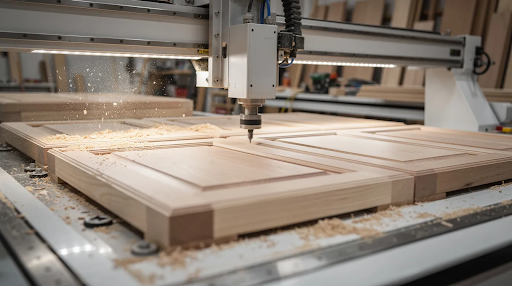
Small woodworking and sign shops represent core users. Custom carved signs up to roughly 30” wide become repeatable operations with consistent quality. Cabinet doors and drawer fronts nest efficiently—a 36” x 48” machine accommodates 4-6 door blanks per sheet of plywood, transforming multi-hour hand routing into 45-60 minute automated cycles. Fixtures, jigs, and templates for downstream production work become affordable to create for even short runs.
Prototyping and light manufacturing benefit from rapid iteration cycles. Short-run production of panels, brackets, and enclosures in plywood, HDPE, or aluminum moves from weeks (if outsourced) to hours (in-house). Product designers verify dimensional concepts at full scale before committing to production tooling.
Education and maker spaces leverage these machines for semester-spanning projects: clocks, instrument bodies, STEM components, robotics chassis, and signage. The combination of manageable footprint, lower noise, and contained dust generation with proper collection makes small format systems educationally superior to larger alternatives.
Cross-material capability includes engraving acrylic for awards and architectural panels, machining MDF for mold patterns, and cutting aluminum plates under conservative parameters. The machines handle various materials within their power envelope.
One generic example: a small cabinet shop with two employees processes custom door production on a 36” x 48” machine. What previously required 2-3 hours of hand routing with quality variation now completes in 45-60 minutes with consistent results. The investment pays for itself within months through labor efficiency gains. Simply Technologies designs its compact CNC and laser systems to handle exactly these use cases—explore options at https://simplytechnologies.xyz/cnc-products/.
Small Format CNC Routers in Education and Training
Small footprint, high-safety CNC routers have become core equipment in high schools, colleges, and community maker spaces across North America. The reasons extend beyond cost.
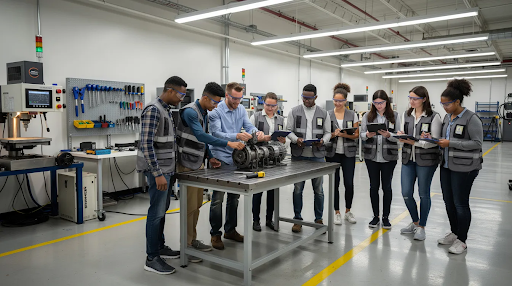
Classroom fit matters practically. These machines work in typical lab rooms and on mobile carts. Instructors can supervise multiple students around a smaller machine with clear sightlines. Lower noise levels and contained dust—when paired with proper collection—create acceptable learning environments without industrial-scale infrastructure.
Simply Technologies’ education-focused offerings address these needs directly. The ACADEMY Series CNC systems are designed specifically for schools and training centers. The EMPOWER[ED] ACADEMY provides a 16-session instructor-led curriculum covering CAD fundamentals, CAM toolpath generation, safe machine operation, and project-based learning. Teacher onboarding, ongoing support with free lifetime technical support, and CSA-compliant systems for Canadian programs create sustainable programs rather than one-time equipment purchases.
Structured curriculum leads to documented skill levels and certifications, helping students transition to industry roles using larger CNC machinery. The progression from classroom small format work to production environments becomes natural rather than jarring.
Many schools pair small format routers with complementary CO2 laser systems—lasers handle thin materials and engraving while routers handle structural components. This combination teaches students when each technology applies, building decision-making skills alongside technical proficiency. Explore laser options at https://simplytechnologies.xyz/laser-machines-and-accessories/.
Planning for Growth: From Entry-Level to Performance ATC
Many users start with a small format CNC and expand capabilities later rather than replacing everything at once. This approach validates products or curriculum before larger commitments.
Simply Technologies’ scalable structure supports this progression. The SIMPLY Series provides entry-level, compact systems for first-time users and light production—reliable machines to learn on and produce with. DISCOVERY and PERFORMANCE Series step up in rigidity, speed, and envelope size while remaining manageable for small shops. PERFORMANCE ATC systems add automatic tool changing for users who need multi-bit jobs without manual intervention.
A typical progression looks like this: start with a compact machine to validate your business concept or curriculum. Add accessories such as dust collection, rotary attachments, and workholding add ons as throughput increases. Move to larger or ATC-equipped machines once workflows, budgets, and space justify the upgrade. Each step builds on previous investments rather than discarding them.
Simply Technologies provides direct technical guidance—including phone support via 800 288 2961—to help customers choose the right point in this progression. Compare small format specs and upgrade paths using the overview at https://simplytechnologies.xyz/cnc-products/ before committing to any one machine size.
Support, Safety, and Implementation Considerations
A small format cnc router purchase is an implementation project involving power, dust collection, training, and support—not just a machine transaction.
Power and Shop Integration: Verify circuits and breakers before purchase. Many compact machines run on 120V or light 240V service, but exact amp draw varies. Position machines on robust benches or stands—possibly on casters for flexible small-shop layouts. Allow space for a computer stand and safe circulation for loading materials.
Dust Collection: This is not optional, especially in educational environments. Dust shoes on cutting tools improves collection efficiency by 50-70%. Plan for 4” diameter ducting connecting to either dedicated dust collectors (minimum 1.5 HP for continuous operation) or capable shop vacuums. Accumulated wood dust creates respiratory hazards and accelerates component wear.
Safety Standards: E-stop placement and accessibility, guarding, interlocks, and adherence to standards like CSA for Canadian installations matter for both regulatory compliance and real protection. Simply Technologies designs systems with education and small production safety in mind, supporting teachers and shop owners through onboarding.
Direct Support: Application-specific guidance on material selection, feeds and speeds, and fixturing makes the difference between frustration and success. Long-term service and parts availability keep machines reliable and productive over years of daily use. Call 800-288-2961 for project-specific and facility-specific questions before purchase.
A concrete example: installing a 36” x 48” router in a 20’ x 20’ shop alongside existing tools requires planning for machine footprint, clearance, dust ducting runs, and electrical access—but remains entirely manageable with basic preparation.
FAQ
How much does a serious small format CNC router typically cost between 2024 and 2026?
Entry-level small format systems with basic spindles and controls fall in the $3,000-$6,000 range. More robust production-capable machines with 2.2 kW spindles, ball screws, and quality controls run $6,000-$15,000. Prices vary with envelope size, motion components, spindle type, and included software or accessories. Quality reviews and real-world performance matter more than finding the absolute lowest cost. Use Simply Technologies’ CNC product pages at https://simplytechnologies.xyz/cnc-products/ as a reference for current configurations.
What shop space and power do I need for a small format CNC router?
Most 18” x 24” to 36” x 48” routers fit in a one-car garage bay or 10’ x 10’ classroom area with clearance on at least two sides. Typical power requirements are 120V or light 240V service—confirm exact specifications for any specific machine before purchase. Plan additional space for dust collection equipment, a computer stand, and safe movement around the device for loading materials. Money spent on proper setup pays dividends in operational efficiency.
What materials can I realistically cut on a small format CNC router?
Most compact production-grade routers handle wood and wood composites (plywood, MDF, solid hardwoods), plastics (acrylic, HDPE, polycarbonate), and non-ferrous metals like aluminum and brass with appropriate tools and conservative parameters. Heavy metal cutting exceeds typical small format capability. Foam and soft materials machine easily. Discuss your primary materials with Simply Technologies support to ensure your chosen machine and spindle are the perfect choice for your applications.
When should I move from a small format CNC router to a larger or ATC-equipped system?
Common triggers include consistently tiling workpieces because your current envelope is too small, spending excessive time on manual tool changes across multi-bit jobs, or running the machine near full-time while needing shorter cycle times. A move to larger work area or PERFORMANCE ATC improves throughput without adding operational complexity. Contact Simply Technologies at 800-288-2961 to schedule a review of current workloads and determine whether upgrading is justified.
How do CNC routers and CO2 lasers complement each other in a small shop or classroom?
CNC routers excel at 2D and 3D machining in thicker stock and structural components—imagine producing cabinet panels or mechanical plates in a single operation. CO2 lasers handle fast, clean cutting and engraving of thin wood, acrylic, and textiles. A typical workflow uses routers for structural parts and lasers for engraving, labels, and decorative elements. This versatile combination creates comprehensive capability in limited space. Explore Simply Technologies’ laser lineup at https://simplytechnologies.xyz/laser-machines-and-accessories/ for systems that pair well with small format CNC routers.
The SIMPLY 8 is our most popular enclosed desktop CNC for shops with limited space. If you need a larger work area, the Performance 6 is the natural step up.
The SIMPLY 8 is our 24×48 enclosed desktop CNC router — a strong choice for school shops, small businesses, and serious makers who need a step up from benchtop size without the footprint of a full production machine. When you’re ready for a production-grade option, the Performance 6 brings iCNC touchscreen control to a 24×36 format built for real shop output.