
For most Canadian sign shops doing acrylic letters, layered signs, HDU profiles, or detail engraving regularly, the answer is usually yes: a properly sized CO2 laser can pay back inside twelve months on labour displacement, though that depends a lot on volume, labour costs, and the right machine match. Some shops see strong returns; others run a laser because it opens up work they couldn’t take on before. This guide walks through one set of numbers to help frame the decision.
What Sign Work a CO2 Laser Actually Replaces or Speeds Up
In a typical Canadian sign shop, a CO2 laser replaces or accelerates:
• Acrylic letter cutting (was: jigsaw or scroll saw + sanding. With laser: one pass, no finishing)
• Layered acrylic signs (was: cut each layer manually + clean edges. With laser: cut all layers in one job)
• HDU profile cuts (was: bandsaw + router. With laser: one operation on most thicknesses up to about 1 inch with higher wattages)
• Detail engraving on wood, leather, and acrylic (was: hand-routing or sanding. With laser: precise repeatable engraving)
• Stencils and templates (was: cut by hand. With laser: cut from any digital design in minutes)
Real Cost of a Sign Shop CO2 Laser
Sign shop ROI math starts with the all-in machine cost. Real numbers from our catalog (the site displays pricing in your local currency: CAD, USD, EUR, or GBP):
• Mira 5S Redline (40W, around $6,999): all-in roughly $8,500 to $10,000 with ventilation and any optional install package
• Mira 7S Redline (60W, around $9,499): all-in roughly $11,500 to $13,000 with ventilation and any optional install package
• Mira 9S Redline (75W, around $10,499): all-in roughly $12,500 to $14,500 with ventilation and any optional install package
• Atlas 4’x8′ 150W (from $26,999 CAD): all-in roughly $30,000 to $34,000 CAD with ventilation and any optional install package
Prices on the site do not include freight. A written quote will include freight to your shop and any applicable duty. Install and training packages are available as add-ons; standalone laser orders ship without on-site setup.
Throughput Comparison: Hand Cutting vs Laser vs CNC Router
Rough throughput comparison for a typical acrylic letter job (10 letters, 3-inch tall, 1/4-inch acrylic):
• By hand (jigsaw + sanding): 90 to 150 minutes including finishing
• On a CNC router: 30 to 45 minutes including bit changes and cleanup
• On a Mira 7S Redline (60W): 8 to 15 minutes including loading and unloading
For shops doing acrylic letter work several times a week, the time savings add up fast.
Sample ROI Calculation for a Canadian Sign Shop
A small sign shop adds a Mira 7S Redline (60W) and runs it about 20 hours per week on acrylic, HDU, and engraving work that was previously done by hand.
• Labour saved: 18 hours per week of manual cutting and finishing
• Shop labour cost: $25/hour
• Weekly labour savings: $25 x 18 = $450
• Annual labour savings: $450 x 50 weeks = $22,500
• Mira 7S Redline all-in cost (machine, ventilation, optional install): around $12,000 to $13,000
Estimated payback on labour displacement in this scenario: roughly seven months. That number swings a lot based on volume, labour costs, and how the shop runs the laser. After payback, the labour time freed up can go toward additional work or new revenue streams. A lot of shops find the bigger benefit is taking on work they couldn’t do before (fine engraving, complex layered signs, and so on) rather than the labour math itself.
Lasers Worth Considering for Sign Making in 2026
Mira 5S Redline (40W): around $7,000. Compact, fits smaller sign shops or entry production.
Mira 7S Redline (60W): around $9,500. A common pick for production sign work.
Mira 9S Redline (75W): around $10,500. Larger production for high-volume sign shops.
Full Spectrum PS24 (90W): around $8,000 on sale. Strong value alternative for industrial mid-range.
AEON Nova 100W series: $13,500 to $18,000. Industrial production with higher wattage.
Atlas 4’x8′ 150W: from $26,999 CAD. Production flatbed for high-volume panel cutting.
All-in budgets above account for the machine, ventilation, and any optional install package. Add another $1,000 to $2,500 for exhaust ventilation and basic electrical if not already in place.
Material Cost Considerations
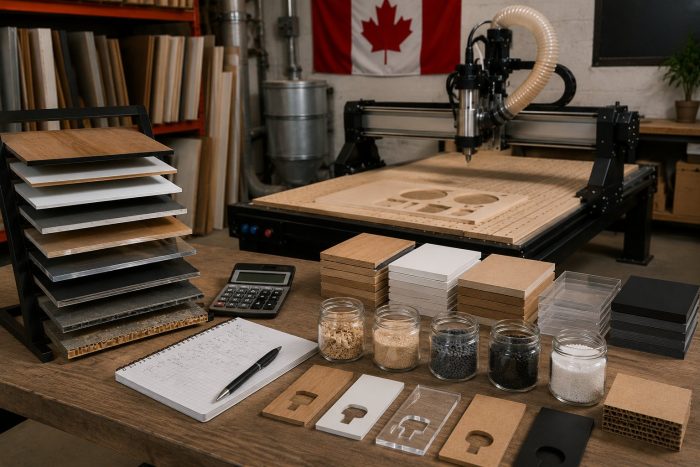
Material costs are generally independent of the machine and similar across the Canadian sign supply market. Rough current figures for sign-shop materials in Canada:
• Acrylic sheet: $80 to $200 per 4×8 sheet depending on thickness and colour
• HDU: $150 to $400 per sheet depending on density and size
• Sign-grade plywood: $60 to $120 per sheet
Get quotes from your local sign material supplier; prices vary by region and order volume.
Common Sign Jobs Where a Laser Earns Its Keep Quickly
Dimensional acrylic letters (replaces jigsaw + sanding workflow)
Layered acrylic signs (cuts all layers in one job)
HDU profile cuts and detail (cleaner edges, no router setup time)
Engraved wayfinding and door signs (precision and repeatability)
Custom awards and promotional products (new revenue stream)
Where Sign Shops Trip Up When Buying Their First Laser
Undersizing the machine
Buying a Mira 5S Redline when the work patterns clearly call for a Mira 7S or 9S. The price gap is smaller than people expect and the long-term ROI is significantly better when the machine matches the work.
Skipping ventilation budget
CO2 lasers need exhaust to the outdoors. Skipping or underspeccing ventilation produces poor cuts and unsafe air quality. Budget $1,000 to $2,500.
Forgetting software
LightBurn is the common pick for new buyers and well worth the modest cost. Free or open-source alternatives exist but the time you spend wrestling with them costs more than the LightBurn licence.
Going DIY on the first install
Mirror alignment, water cooling setup, and software configuration affect cut quality and machine longevity. Experienced operators handle this in-house; first-time CO2 buyers often save themselves months of poor performance by adding an install package.
Frequently Asked Questions
What’s a realistic payback period for a sign shop laser?
For a shop running the laser fifteen to twenty-five hours per week on work that was previously done by hand, we typically see payback land in the six to twelve month range on labour displacement. That varies based on volume, labour costs, and shop workflow. Some shops never run the formal ROI math and value the machine for the additional work it lets them take on rather than the labour savings.
Which Mira is right for a Canadian sign shop?
The Mira 7S Redline (60W, around $9,499) is a common pick for production sign work. For smaller volume or budget-constrained shops, the Mira 5S Redline (40W, around $6,999) works. For higher volume, the Mira 9S Redline (75W, around $10,499) provides headroom.
Do I need ventilation for a CO2 laser?
Yes. CO2 lasers require exhaust ventilation to the outdoors. Plan $1,000 to $2,500 for ventilation infrastructure depending on shop layout and existing exhaust.
Can a CO2 laser replace my CNC router for sign work?
No, they do different work. A CNC router handles thicker material, dimensional carving, and structural panel work. A CO2 laser handles acrylic letters, fine detail, and engraving. Most successful sign shops run both.
How long does it take to learn the laser?
Most operators are producing basic cuts within the first day of focused training and running confident production work within a week.
Get a Laser Quote for Your Sign Shop
If you’re a Canadian sign shop owner thinking about adding a CO2 laser, get in touch for a no-pressure conversation. Tell us what you’re cutting and how much, and we’ll point you at the right Mira (or alternative) and put together a written quote.