
A CNC router earns its place in your shop when it runs cleanly, safely, and reliably. That means a properly sized dust collector, sensible ducting, the right power setup, and a shop layout that supports the workflow. This guide covers the practical setup decisions for small Canadian shops running a small-format CNC.
Why Dust Collection Matters
CNC routers produce fine wood dust at high volume. Without proper collection you’re creating three real problems: a fire hazard (fine dust suspended in air is explosive), a health hazard (fine particulate damages lungs over time), and a maintenance problem (dust fouls bearings, drives, and electronics and shortens machine life).
Even a small DISCOVERY 1 desktop CNC benefits from a basic dust shoe and a shop vacuum. A 24″ x 48″ PERFORMANCE 8 or 48″ x 48″ PERFORMANCE 16 needs a properly sized collector to keep the shop clean and safe.
Types of Dust Collection Systems
Shop vacuum + dust shoe
Right for desktop and benchtop CNCs (DISCOVERY 1, DISCOVERY 2, ACADEMY series). A standard shop vacuum with a HEPA filter plus a dust shoe attached to the spindle captures most chips and fine dust. Dust shoes are sold as a standalone accessory on our product pages.
Single-stage dust collector
Right for 24″ x 48″ and 48″ x 48″ production CNCs (SIMPLY 8, DISCOVERY 8/16, PERFORMANCE 8/16). A 1.5HP to 2HP single-stage collector with a 4-inch or 5-inch main duct handles the volume from a small-format CNC running daily.
Cyclone or two-stage system
Right for shops running the CNC alongside other dust-producing tools (table saw, jointer, planer). A cyclone separates chips from fine dust before the filter, extending filter life and improving collection efficiency.
CFM Requirements by CNC Bed Size
Approximate target airflow at the dust shoe for clean collection:
• 12″ x 12″ desktop CNC (DISCOVERY 1, ACADEMY 1): 100 to 200 CFM. A standard shop vac handles this.
• 12″ x 24″ CNC (DISCOVERY 2, ACADEMY 2): 200 to 300 CFM.
• 24″ x 48″ CNC (SIMPLY 8, DISCOVERY 8, PERFORMANCE 8): 350 to 500 CFM.
• 48″ x 48″ CNC (DISCOVERY 16, PERFORMANCE 16): 500 to 800 CFM.
These numbers are at the dust shoe, not at the collector. Static pressure losses in ducting reduce effective CFM, so size the collector with headroom.
Ducting Layout and Static Pressure Basics
Use the shortest possible run from the CNC to the collector. Every 10 feet of straight 4-inch duct adds roughly 0.1 inches of water static pressure. Every 90-degree elbow adds the equivalent of about 5 feet of straight duct. Smooth metal duct is far better than corrugated flex hose for long runs.
Use 5-inch or 6-inch main runs reduced to 4-inch at the dust shoe. Avoid long runs of 4-inch duct as the main collection line. Keep blast gates close to the machine so unused branches don’t bleed off airflow.
Filter Standards
Filter rating matters for fine dust. Look for a collector with a filter rated for sub-micron particle capture (most current single-stage collectors meet this). If you’re running an older collector with a bag filter, upgrade the bag; paper or felt bags release fine dust back into the shop.
Recommended Dust Collection Setups by Shop Type
Classroom or makerspace running DISCOVERY 1/2 or ACADEMY
Shop vacuum with HEPA filter ($150 to $300) plus dust shoe. Total: roughly $500 to $700 for clean collection on a desktop or classroom CNC.
Small sign shop running PERFORMANCE 8 (24″ x 48″)
1.5HP single-stage collector ($600 to $1,200) plus 4-inch ducting and blast gates ($200 to $500) plus dust shoe. Total: roughly $1,200 to $2,000 for a properly sized setup.
Small custom shop running PERFORMANCE 16 (48″ x 48″)
2HP single-stage or cyclone collector ($1,200 to $2,500) plus 5-inch or 6-inch ducting and blast gates ($400 to $800) plus dust shoe plus the overarm dust accessory. Total: roughly $2,500 to $4,500 for a properly sized setup.
Shop Layout Considerations Around Your CNC
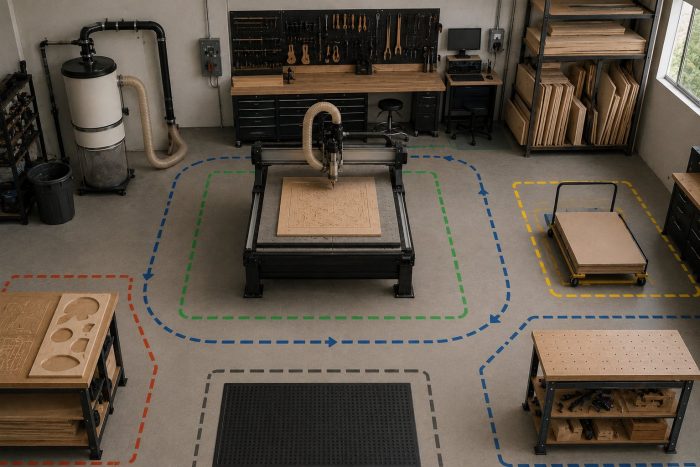
Plan for working room on all four sides of the machine. You’ll be loading and unloading material, checking cuts, changing bits, and clearing chips. A PERFORMANCE 16 (48″ x 48″) wants roughly 2 to 3 feet of clear floor on each side.
Locate the computer or tablet station within easy reach but out of the dust path. Keep tooling, bits, and consumables stored close to the machine. Plan a material staging area near the door so loading and unloading don’t require trips across the shop.
Lighting matters. CNC work involves checking cuts, reading toolpaths on screen, and visually verifying material setup. LED overhead lighting plus a task lamp at the machine is the standard setup.
Power Requirements: Single Phase vs Three Phase in Canadian Shops
Good news for Canadian small shops: every CNC in our small-format lineup runs on standard single-phase power. The DISCOVERY 1 and 2 run on 110V (15A) or optional 220V. The DISCOVERY 8/16 and the entire PERFORMANCE series run on 220V single-phase at 10A.
You don’t need three-phase power. You don’t need a panel upgrade. You don’t need industrial electrical service. If your shop has a 220V single-phase outlet (or can have one installed by an electrician at modest cost), you can run any of our CNC routers.
Common Mistakes Canadian Shops Make Setting Up CNC
Undersizing the dust collector
A shop vacuum on a 48″ x 48″ PERFORMANCE 16 leaves chips on the bed and fine dust in the air. Match the collector to the machine, not the budget.
Long runs of 4-inch flex hose as the main line
Static pressure losses kill airflow. Use rigid metal duct in 5-inch or 6-inch for the main run.
Locating the CNC against a wall
Loading material, changing bits, and clearing chips all need access. Plan working room on all four sides.
Skipping the dust shoe
Even with a great collector, you need a shoe at the spindle to capture chips at the cut. The shoe earns its keep in cleaner cuts and less cleanup.
Assuming you need three-phase
Small-format CNCs run on single-phase. Don’t pay for electrical upgrades you don’t need.
Frequently Asked Questions
How much should I budget for dust collection?
For a typical small-format CNC, plan $1,000 to $4,500 depending on machine size and existing shop infrastructure. A desktop CNC needs roughly $500 to $700. A PERFORMANCE 16 with proper ducting wants $2,500 to $4,500 for a clean install.
Can I run a CNC without dust collection?
Not safely. Fine dust is a fire hazard, a health hazard, and shortens machine life. Even on a desktop CNC, run at minimum a shop vac with a dust shoe.
Do I need three-phase power?
No, not for any CNC in our small-format lineup. All run on single-phase: 110V on desktop models, 220V single-phase at 10A on production models.
What CFM do I need for a 48″ x 48″ CNC?
Target 500 to 800 CFM at the dust shoe. Size the collector with headroom because static pressure in ducting reduces effective CFM.
Does Simply Technologies sell dust collection?
We sell dust shoes and the overarm dust accessory for the PERFORMANCE series. For collectors and ducting we recommend working with a Canadian dust collection supplier that can size and quote a complete system for your shop.
Talk to Us About Your Shop Setup
If you’re planning a CNC install and want to talk through dust collection, power, and shop layout, get in touch. We’ll help you spec the install so the machine runs cleanly from day one.