
Key Takeaways
- Entry level CNC machines in 2026 typically offer 24” x 32” to 4’ x 4’ work areas, run on GRBL or industrial controllers, and handle wood, plastics, and aluminum reliably.
- Simply Technologies’ SIMPLY Series CNC routers are engineered as true entry level shop and classroom machines—not hobby toys—with welded frames and industrial spindles.
- Beginners should prioritize machine rigidity, safety features (emergency stop, CSA-compliant enclosures for schools), and accessible CAD/CAM software over chasing max speed or wattage.
- Users can start with an entry level router and scale into DISCOVERY and PERFORMANCE series machines as production volume, class enrollment, or part complexity grows.
- CO2 lasers and basic automation (dust collection, tool length sensors) can be added later to extend capability without increasing operational complexity.
Choosing your first CNC machine feels overwhelming. The 2026 market offers everything from $300 desktop kits to $50,000 shop routers, and the specs alone—spindle power, work area, controller type—can bury a first-time buyer in details that don’t clarify which machine actually fits their needs.
This guide cuts through that noise. Whether you’re setting up a garage shop, launching a small production business, or outfitting a school manufacturing lab, understanding what separates a reliable entry level CNC from a fragile hobby device will save you money, frustration, and wasted projects. We’ll cover the core features that matter, who these machines serve best, and how to plan for growth when your first router can no longer keep up.
What Is an Entry Level CNC Machine in 2026?
An entry level CNC machine is a compact, affordable router or mill designed for first-time users in small shops, schools, and maker spaces. These systems automate subtractive manufacturing by precisely controlling tools along multiple axes—typically 3-axis for X, Y, and Z motion—to cut, carve, or mill materials using G-code instructions from CAD/CAM software.
In 2026, most entry level CNC routers offer envelope sizes from roughly 600 x 900 mm (24” x 36”) up to 1300 x 2500 mm (4’ x 8’), optimized for wood, plastic, and light aluminum work. They run on GRBL (open-source) or industrial controllers and feature spindles ranging from 1.5 to 3.0 kW.
The critical distinction lies between hobby kits and true shop routers:
- Hobby kits (3018-style open-frame machines) use aluminum extrusion frames, 100W spindles, and V-wheels prone to flex—limiting them to soft materials and light cuts with poor repeatability.
- True entry level shop routers feature welded steel frames, industrial air-cooled spindles with ER collets, linear guides, and safety compliance for daily institutional use.
- Simply Technologies manufactures CNC systems specifically engineered for repeated daily operation in real classrooms and production environments, distinguishing their equipment from disposable hobby machinery.
Who Are Entry Level CNC Machines For?
Entry level CNC machines support three main groups: hobbyists and makers working from home or shared workshops, small production shops generating revenue from fabrication, and education programs from middle school through college. Each group brings different requirements to the purchase decision.
- Hobbyists and makers need machines with a small footprint that fit in a garage or basement, 120V power compatibility for standard outlets, and reasonable noise levels for residential environments. Projects typically include woodworking, carving, signage, and prototyping personal ideas.
- Small businesses (sign shops, custom furniture makers, prototyping labs) require repeatable precision—typically ±0.005” for production jobs—plus standard workholding, ability to produce parts consistently across short runs, and simple job changeover between boards and materials.
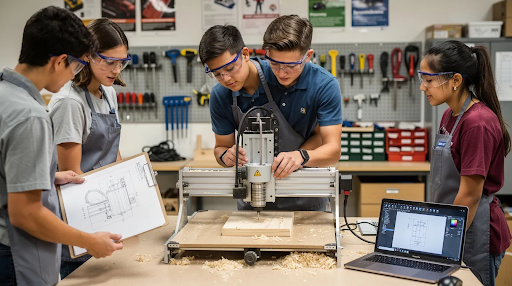
- Educators expect CSA-compliant safety features for Canadian installations, intuitive interfaces students can operate without extensive machinist training, and durability across multiple semesters of student use. Reliability matters more than cutting-edge specs.
- Simply Technologies’ ACADEMY Series and EMPOWER[ED] ACADEMY are structured to support schools purchasing their first CNC with curriculum, teacher training, and certification pathways that reduce the burden on instructors launching new manufacturing programs.
Core Features to Look for in an Entry Level CNC Router
Before purchasing any entry level CNC router, use this practical checklist to compare machines. These features separate tools you can rely on from equipment that will frustrate you within months.
Frame and Rigidity
- Welded steel frames prevent deflection during cuts in plywood and aluminum; lightweight aluminum extrusion frames flex under load, producing wavy edges and chatter marks.
- True shop routers handle 500+ lbs of gantry load; hobby kits max out around 200 lbs before performance degrades.
Motion System
- Linear guides (THK-style rails) deliver 0.001” backlash-free motion, critical for quality in aluminum and detailed woodworking.
- V-wheel systems introduce 0.01” slop, acceptable only for soft materials and forgiving tolerances.
- Ballscrew drives offer precision over belt drives; expect belts on machines under $5,000 and ballscrews on shop-grade entry level equipment.
Spindle
- Look for 1.5–3.0 kW air-cooled or water-cooled spindles with ER collets (ER11 or ER20).
- Avoid trim router conversions—they overheat beyond 2 hours of continuous operation and lack the precision bearings required for quality cuts.
- Entry level shop spindles typically run 6,000–24,000 RPM with variable speed control.
Safety Features
- Emergency stop buttons with <50ms response time are non-negotiable.
- Limit switches and homing prevent crashes during operation.
- Proper cable management (cable chains) eliminates snag hazards.
- Enclosed or partially-enclosed work areas reduce 90% of dust escape—essential for classrooms and shops without dedicated rooms.
Software Compatibility
- Beginners often start with Fusion 360 (free hobby tier), VCarve, or Easel for CAM workflows.
- Avoid machines that lock you into obscure, unsupported proprietary software—this limits your ability to grow and get community support.
- Explore Simply Technologies’ CNC product overview for systems built around these core features with accessible pricing.
Simply Technologies CNC Lineup for Entry Level Users
Simply Technologies structures its CNC router lineup as a progression, allowing users to start entry level and scale capacity without changing workflows or relearning software. This staged approach protects your initial investment while providing clear upgrade paths.
- SIMPLY Series serves as the primary entry level CNC machine line, featuring compact footprints suited for small shops and educational labs. These machines operate on 120V or 240V depending on model, making installation straightforward in most facilities.
- DISCOVERY Series represents the next step up, offering larger work envelopes, heavier gantries for improved rigidity, and options for higher-power spindles. This series handles more demanding materials and supports light production volumes.
- PERFORMANCE and PERFORMANCE ATC Series provide growth paths when automatic tool changing, longer unattended run times, and higher throughput become necessary. Control interfaces remain consistent across the lineup, minimizing retraining.
- Individual machine specifications including work area, spindle options, and controller details are available on the Simply Technologies site for direct comparison.
- The consistent interface philosophy means skills learned on a SIMPLY Series transfer directly to larger machines—an excellent choice for programs expecting enrollment growth or shops anticipating increased production.
Entry Level CNC in Education: ACADEMY Series and EMPOWER[ED] ACADEMY
Many entry level CNC purchases in 2026 are driven by schools launching new manufacturing, STEM, and design programs. Statistics indicate educational adoption is growing approximately 30% as curriculum standards increasingly include digital fabrication skills.
- ACADEMY Series CNC systems are configured specifically for classrooms, featuring safety guarding, standardized workholding, and controller options aligned with student skill levels. These machines meet the reliability requirements of semester-long daily use.
- EMPOWER[ED] ACADEMY provides a 16-session structured curriculum covering CAD modeling, CAM toolpathing (pocketing, profiling), machine setup, and basic maintenance. The program targets both students and teachers new to CNC machinery.
- Education packages typically include CAD/CAM training, certification pathways for students demonstrating competency, and teacher onboarding that reduces preparation burden on instructors without manufacturing backgrounds.
- Safety compliance meets CSA certification requirements for Canadian installations and equivalent NRTL standards, featuring interlocks, low-voltage controls, and enclosures that satisfy institutional safety committees.
- Schools should contact Simply Technologies’ education team at 800 288 2961 to align machine selection, room layout, power requirements, and curriculum integration before purchase.
How Entry Level CNC Machines Compare to Lasers and Other Tools
CNC routers, CO2 lasers, and 3D printers all use digital workflows and computer-controlled operation, but they serve fundamentally different roles for entry level users building their first fabrication capability.
- CNC routers excel at structural parts: woodworking projects, cabinet components, signmaking in thick materials, fixtures, jigs, and aluminum plates for brackets. They handle machining processes that require removing significant material and producing parts with dimensional accuracy.
- CNC routers are the better first purchase when your primary work involves furniture, cabinetry, production prototyping, or any project requiring assembly of multiple components with tight-fitting joints.
- CO2 lasers are more appropriate for thin plywood, acrylic signage, and classroom projects requiring fast engraving with minimal cutting forces. They complement routers rather than replacing them.
- Simply Technologies positions CNC routers as the core of the workshop, with CO2 laser systems serving as complementary tools that expand project possibilities without duplicating capability.
- 3D printers remain useful for additive prototyping and fixtures, but they cannot match CNC router throughput, material strength, or precision in wood and aluminum—they’re supplementary tools, not alternatives.
Scaling from Entry Level CNC to Production
Many users outgrow their first entry level router within 18–36 months as projects multiply, class enrollment increases, or customer orders demand faster turnaround. Recognizing when to scale—and planning the upgrade path in advance—prevents productivity bottlenecks.
- Signs you need more capability: machine running full days consistently, frequent manual tool changes slowing jobs, moving into harder materials like aluminum and composites regularly, or quality requirements exceeding your current machine’s precision.
- Simply Technologies supports scaling by maintaining consistent user interfaces, training materials, and support structures across SIMPLY, DISCOVERY, and PERFORMANCE Series machines. Skills transfer directly without steep learning curve interruptions.
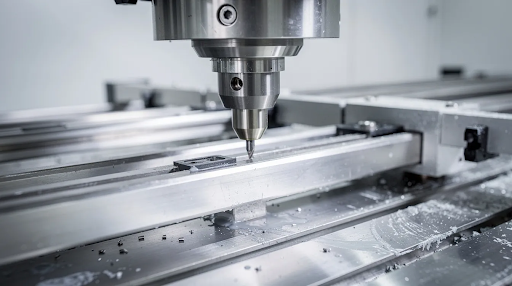
- Accessories extend entry level machine life: dust collection upgrades (500+ CFM recommended), vacuum tables for sheet goods, rotary attachments for cylindrical work, tool setters, and probing systems can double effective capacity before a full machine upgrade becomes necessary.
- Staged upgrade path: Start with SIMPLY Series for learning and prototyping, move to DISCOVERY for expanded capacity and heavier materials, graduate to PERFORMANCE ATC when automatic tool changes and continuous unattended production become necessary.
- Call 800 288 2961 to discuss upgrade timelines, budget planning, and whether adding a second entry level CNC machine or stepping up to larger machines makes more sense for your specific workflow.
Getting Started: Training, Support, and First Projects
The steepest part of the learning curve happens in the first few weeks. Structured training and realistic expectations reduce scrap, prevent frustration, and get you producing quality parts faster than trial-and-error alone.
- First 30 days: Install and commission the machine (level the frame, home all axes), run manufacturer test files to verify operation, then practice basic 2D profiles and pocketing on MDF or plywood before moving to expensive stock.
- Beginner projects build skills progressively: shop signs, simple jigs, flat-pack furniture components, and organization boxes teach tool changes, zeroing procedures, and feeds and speeds without high-stakes pressure.
- Simply Technologies provides direct technical support, application guidance, and remote onboarding sessions for new CNC installations. This support structure shortens the path from unboxing to confident operation.
- Community accelerates learning: participate in local maker spaces, online forums, or vendor-led training sessions to troubleshoot early challenges and learn techniques beyond basic operation.
- Expect confident independent operation after 4–8 weeks of regular hands-on time—structured programs like EMPOWER[ED] ACADEMY can cut this timeline significantly for both students and instructors.
FAQ
How much should I budget for a reliable entry level CNC router in 2026?
Serious entry level shop and classroom CNC routers typically start in the low five-figure (USD) range, with pricing varying based on work area and spindle specifications. Ultra-low-cost hobby kits under $1,000 are not suitable for daily institutional or production use—they lack the rigidity, safety features, and reliability required for consistent output.
Budget an additional 20% beyond machine price for essential accessories: tooling (end mills, collets), dust collection, workholding clamps, and basic measurement tools. Contact Simply Technologies for ballpark package pricing based on your specific application.
Can an entry level CNC router cut aluminum reliably?
Yes—many modern entry level CNC routers with rigid frames and proper spindles machine aluminum plate and extrusions reliably when feeds, speeds, and workholding are configured correctly. Expect to run approximately 80 IPM at 0.02” depth of cut with mist coolant for consistent results.
Buyers specifically targeting soft metals should prioritize machines with ballscrew drives, robust gantries, and well-supported CAM workflows. The DISCOVERY and PERFORMANCE lines serve as natural upgrade paths when aluminum work becomes a primary focus rather than occasional jobs.
What power and space do I need for my first CNC router?
Most compact entry level routers run on standard single-phase power—commonly 120V for smaller machines or 240V depending on region and spindle size. Footprint requirements resemble a large workbench (roughly 4’ x 4’ for the machine) plus clearance for loading materials and operator access.
Verify electrical capacity and dust collection requirements with Simply Technologies before purchase, especially for school labs and shared maker spaces where power availability may be limited.
How long does it take a beginner to become productive on CNC?
Most motivated users complete simple, repeatable projects within a few days of hands-on time. Confident, independent operation—selecting appropriate tools, setting feeds and speeds, troubleshooting common issues—typically develops after 4–8 weeks of regular use.
Structured programs like the 16-session EMPOWER[ED] ACADEMY curriculum significantly shorten this learning curve for both teachers and students, providing systematic skill development rather than scattered trial-and-error learning.
Should I start with a CNC router or a CO2 laser for my school or makerspace?
CNC routers handle structural parts, furniture components, and materials thicker than 1/2”—they’re the foundation for manufacturing and fabrication programs. CO2 lasers excel at fast engraving and cutting thin sheet materials like 1/4” plywood and acrylic, with minimal cutting forces and quick setup.
Programs focused on manufacturing, woodworking, and fabrication should begin with a CNC router as the primary machine. Add a CO2 laser from Simply Technologies as a secondary tool to expand project options once router workflows are established.