
A CO2 laser cutter is one of the most versatile production tools you can put in a Canadian shop, classroom, or makerspace. If you are equipping a classroom, our guide to CO2 laser cutters for schools covers the safety, ventilation, and setup side. It cuts and engraves wood, acrylic, leather, paper, fabric, HDU, and most non-metallic materials with precision that hand cutting and other methods can’t match. Pricing in our lineup runs from around $2,500 (Muse Core 40W on sale) up to the Atlas 4’x8′ 150W flatbed starting at $26,999 CAD. The right machine depends on what you’re cutting, how often, and at what scale. This guide walks through what CO2 lasers do, how they compare to other cutting tools, what to look for, and how to buy.
What Is a CO2 Laser Cutter and What Does It Cut
A CO2 laser cutter uses a carbon dioxide gas tube to generate a focused beam of infrared light. The beam vaporizes material along a programmed path, producing clean cuts and detailed engravings on a wide range of non-metallic materials.
Materials a CO2 laser cuts well:
• Wood (plywood, MDF, hardwood up to about 1/2 inch depending on tube power)
• Acrylic (clear, coloured, frosted)
• Leather and textiles
• Paper, cardboard, and chipboard
• HDU (high-density urethane) for sign work
• Foam, rubber, and some plastics
Materials a CO2 laser cannot cut:
• Bare metal (steel, aluminum, brass, copper). Use a fibre laser or plasma instead.
• PVC and vinyl (produces toxic chlorine gas that damages the machine and is unsafe to breathe)
• Materials with unknown coatings or fire-retardant treatments
CO2 Laser vs Fibre Laser vs CNC Router
CO2 Laser
Best for non-metallic cutting and engraving. Most versatile for small shops doing signs, custom work, and engraving.
Fibre Laser
Best for metal cutting and metal marking. Different machine class, different price point. We don’t currently stock fibre lasers; if metal cutting is your fit we’ll point you elsewhere.
CNC Router
Best for thicker material, structural panel work, and 3D milling. Cuts plywood, MDF, hardwood, plastics, composites, foam, acrylic, and non-ferrous metals. Pairs well with a CO2 laser in a shop doing mixed work.
How Much Does a CO2 Laser Cost
Real-world pricing from Simply Technologies (product page pricing; the site displays your local currency: CAD, USD, EUR, or GBP):
• Muse Core 40W: around $2,500 on sale (regularly $3,799). Compact desktop.
• Muse 3D 40W: around $3,000 on sale (regularly $6,499). Desktop with 3D capability.
• Muse Titan 75W: around $5,000 on sale (regularly $9,495). Mid-range Muse.
• Mira 5S Redline 40W: from around $6,999. Compact production CO2.
• Mira 7S Redline 60W: from around $9,499. Mid-range workhorse.
• Mira 9S Redline 75W: from around $10,499. Larger production.
• Full Spectrum PS series 45W to 90W: roughly $5,649 to $11,745. Industrial range.
• AEON Nova 100W: roughly $13,495 to $17,995. Industrial production.
• Atlas 4’x8′ 150W flatbed: from $26,999 CAD. The only 4’x8′ machine in the catalog.
Prices on the site do not include freight. A written quote will include freight to your shop and any applicable duty.
Key Specs That Actually Matter
Tube power (wattage)
Determines cutting speed and material thickness. 40W handles most engraving and thin cutting. 60W is a comfortable production sweet spot. 75W and 90W cut faster on thicker material. 100W and 150W sit at the top of the lineup for high-volume work.
Bed size
Match to your typical part size. Desktop machines fit small parts and engraving. Mid-range Mira lasers handle most sign work. Atlas 4’x8′ fits full panel material.
Tube type
CO2 glass tubes (used in most machines under $20,000) last 8,000 to 10,000 hours of cutting time and are replaceable. RF metal tubes last longer but cost significantly more.
Software
Most CO2 lasers run LightBurn or RDWorks. Both are mature, widely-used, and well-documented. LightBurn is generally easier to learn.
Cooling
Most production CO2 tubes use water cooling. Compact desktop machines may use air cooling. Water cooling extends tube life under heavy use.
CO2 Lasers Worth Looking At in 2026
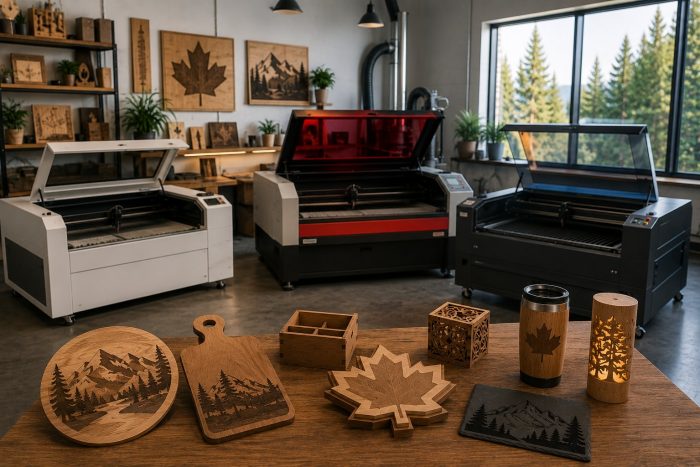
Based on the configurations buyers ask about most.
Mira 5S Redline (40W) — entry production laser
From around $6,999. Compact bed, single-phase. A common pick for schools, makerspaces, smaller sign shops, and shops just adding laser capability.
Mira 7S Redline (60W) — mid-range workhorse
From around $9,499. Larger bed, more cutting depth, single-phase compatible. A common choice for production sign shops.
Mira 9S Redline (75W) — larger production
From around $10,499. Larger bed and more power for shops running the laser through most of the workday.
Full Spectrum PS24 (90W) — industrial mid-range
Around $7,995 on sale (regularly $8,995). Strong value for shops needing 90W in an industrial form factor.
Atlas 4’x8′ 150W — production flatbed
From $26,999 CAD. The only 4’x8′ machine in our catalog. Built for production cutting at panel scale with a double work platform for continuous loading.
Material Compatibility
Verify before cutting anything you’re unsure about. Cutting the wrong material (PVC, certain coated boards, anything with chlorine) damages the machine and creates serious health and safety issues. Most non-metallic materials marked as ‘laser safe’ by suppliers are fine, but always verify thickness limits against your machine’s tube power.
Safety, Ventilation, and Installation Requirements
CO2 lasers need exhaust ventilation to the outdoors to remove smoke and fumes from cutting. Plan $1,000 to $2,500 for ventilation infrastructure depending on shop layout and existing exhaust. Larger industrial systems may need more substantial venting.
Other install considerations: stable workbench or floor space sized for the machine, water cooling setup (for water-cooled tubes), and a clear path between the machine and the exhaust route. Standalone laser orders ship without on-site setup. Optional install and training packages are available when your team wants help getting the machine dialed in.
Buyer Checklist
• Confirm what materials you’ll be cutting and at what thickness
• Measure available floor space including ventilation routing
• Confirm electrical: most lasers in our lineup are single-phase compatible
• Budget for ventilation ($1,000 to $2,500) on top of machine price
• Decide on software (LightBurn is the common pick for new buyers)
• Plan for ramp-up time on the software and machine
• Get a written quote that includes freight and any applicable duty
A Note on Education Buyers
For schools and post-secondary programs, EMPOWER[ED] ACADEMY pairs CAD and CNC certification with structured curriculum, teacher onboarding, and student certification. It’s built for classroom continuity so the program is still running well after the first cohort graduates, and it’s one of the things that separates our education offer from a standard hardware purchase.
Where to Buy a CO2 Laser in Canada
A few paths exist: import direct from overseas, buy from a US-only seller, or buy through Simply Technologies. We’ve been supplying and shipping CNC solutions from London, Ontario since 2009, and more recently, introduced a line of proven laser systems for our clients. CNC parts and accessories ship from our London warehouse; laser parts and consumables come from the manufacturer, and we coordinate warranty support and parts ordering on your behalf.
Frequently Asked Questions
How much does a CO2 laser cost in Canada?
The lineup runs from around $2,500 (Muse Core 40W on sale) up to the Atlas 4’x8′ 150W flatbed from $26,999 CAD. Most small shops doing regular production work end up between $7,000 and $13,000. The site displays pricing in your local currency. A quote will include freight and any applicable duty.
What materials can a CO2 laser cut?
Wood, acrylic, leather, paper, cardboard, fabric, HDU, foam, rubber, and most non-metallic materials. Cannot cut bare metal. Cannot cut PVC or vinyl safely (produces toxic gas).
Do CO2 lasers need three-phase power?
Most CO2 lasers in our lineup run on standard single-phase power. The Atlas industrial flatbed and larger industrial Nova configurations may have higher electrical requirements. We confirm before recommending.
What ventilation does a CO2 laser need?
Exhaust ventilation to the outdoors. Budget $1,000 to $2,500 for ventilation infrastructure depending on shop layout and existing exhaust.
How long does it take to learn?
Most operators produce basic cuts within the first day of focused training and run confident production work within a week. The software (LightBurn or RDWorks) is more straightforward than CNC router CAM. Training packages are available as an add-on if your team wants help getting up to speed.
How long does the laser tube last?
CO2 glass tubes typically last 8,000 to 10,000 hours of cutting time under normal use. Tubes are replaceable. Replacement tubes are sourced from the manufacturer and we coordinate ordering on your behalf.
Talk to Us About Your Laser Purchase
Tell us what you’re cutting and we’ll point you at the right machine. No high-pressure sales. Just experienced answers from a North American CNC company that’s been supporting and shipping CNC and laser systems from London, Ontario since 2009.