
When a Shop Is Ready for PRODUCTION.
There’s a point in nearly every growing shop where something subtle changes.
The work is coming in.
Customers are happy.
Projects are getting larger, more complex, and more frequent.
Yet somehow, the days feel shorter, the margins tighter, and the workload heavier than it should.
That moment isn’t about ambition – it’s about production readiness.
And it’s far more common than most shop owners realize.
__________
The Reality of Small Manufacturing Today.
Across North America, the woodworking and cabinet industry is dominated by small, owner-operated shops.
Industry data consistently shows that:
-
Over 90% of cabinet and woodworking businesses employ fewer than 20 people.
-
A large percentage are single-owner or family-run.
-
Many operate out of home garages or small commercial spaces, especially in their early growth years.
This matters, because most shops don’t start with production infrastructure.
They grow into it – often without realizing it.
That’s why the moment a shop feels “stuck” is rarely about lack of skill.
It’s about mismatch between how the shop is set up and how the work is now flowing.
__________
Production Isn’t About Size. It’s About Repetition.
A common misconception is that production begins when you buy a bigger machine.
In reality, production begins when repetition becomes normal.
Cabinet parts repeat.
Furniture components repeat.
Sheet goods move through the shop weekly instead of occasionally.
At that point, setup time starts to compete with cutting time — and inefficiencies compound quietly.
This is especially true in cabinet and furniture manufacturing, where consistency and throughput matter more than novelty.
The Hidden Cost of Staying “Small” Too Long.
Most shop owners already work hard.
What changes at the production threshold isn’t effort — it’s load.
Research around small manufacturing productivity shows that some of the largest time losses don’t come from cutting speed, but from:
-
Manual tool changes
-
Repeated setups
-
Excessive material handling
-
Re-zeroing and re-fixturing
In practice, that often looks like:
-
Larger jobs that feel disruptive instead of profitable
-
Evenings and weekends disappearing
-
Growth that adds stress instead of stability
This is where many shops plateau — not because they’re doing anything wrong, but because their workflow was never designed for repeatable volume.
__________
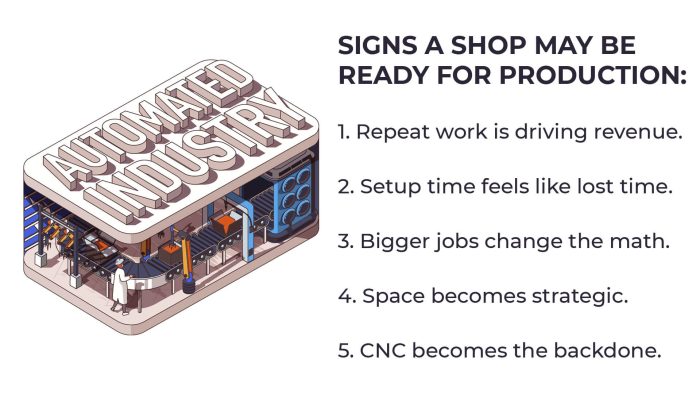
Signs a Shop Is Ready for PRODUCTION.
1. Repeat Work Is Driving Revenue
If a meaningful portion of your income comes from cabinets, furniture parts, or standardized components, consistency becomes more valuable than flexibility. Production always favours predictability.
2. Setup Time Feels Like Lost Time
When setups, tool changes, and repositioning consume hours each week, the bottleneck isn’t motivation — it’s process.
3. Bigger Jobs Change the Math
Large projects should increase margin.
When they instead increase exhaustion, something in the workflow needs to change.
4. Space Becomes Strategic
Material staging, loading, and flow start to matter as much as the machine itself. Space stops being “nice to have” and becomes part of the system.
5. CNC Becomes the Backbone
At this stage, CNC isn’t a capability – it’s the center of scheduling, consistency, and profitability.
That’s a production signal.
__________
Production Is a Response, Not a Leap.
It’s worth saying clearly:
Production isn’t about ego, horsepower, or chasing bigger equipment.
It’s a response to clarity.
Sometimes that clarity leads to better process and tooling.
Sometimes it leads to changes in layout and workflow.
And sometimes, it leads to machines designed specifically for full-size, repeatable work – particularly in cabinet and furniture manufacturing, where sheet goods dominate.
The important thing is knowing why the transition is happening.
__________
A Final Thought.
Most shop owners never set out to “become a production shop.”
They simply follow the work.
And when the work starts repeating (when success begins to demand more than it gives back), production isn’t a risk.
It’s a signal.
At Simply Technologies, we’re seeing this pattern more and more clearly. That’s why we’ve been quietly working on solutions designed specifically for shops that have reached this stage – where CNC is no longer optional, and workflow matters as much as capability.
More on that soon.
For now, if your workflow feels heavier than it should (in time, energy, or margin) you’re not behind.
You may just be ready for production.