
Key Takeaways
- A small industrial CNC machine bridges the gap between hobby-level desktop systems and full-scale factory equipment, delivering production-grade precision in a compact footprint suitable for small shops, schools, and maker spaces.
- Modern small industrial CNC routers from Simply Technologies run on standard single-phase power while maintaining rigidity, repeatability, and multi-shift reliability.
- Buyers can enter with SIMPLY or DISCOVERY Series machines and scale to PERFORMANCE and PERFORMANCE ATC systems as production demands increase.
- Real-world applications span wood, plastics, aluminum, and composites—from cabinet components to robotics parts to educational STEM projects.
- Simply Technologies provides technical support, structured ACADEMY training, and direct guidance for selecting the right machine configuration.
What Is a Small Industrial CNC Machine?
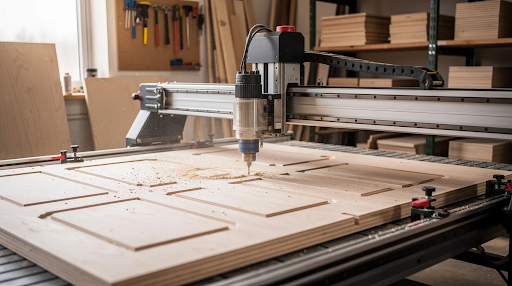
A small industrial CNC machine is a compact CNC router or mill engineered for daily production use rather than occasional hobby work. These systems feature industrial-grade frames, quality linear motion components, and control systems designed for consistent output across extended runs.
Typical work envelope dimensions range from roughly 2’×3’ to 4’×4’ cutting areas—sized to fit small production shops, school labs, and maker spaces without consuming excessive floor space. Unlike desktop home CNC machine systems built with lighter aluminum frames for hobbyists, small industrial CNC machines use welded steel or heavy aluminum construction for vibration control and durability.
Simply Technologies focuses on small industrial CNC routers suited to real production environments. These CNC machines commonly run on single-phase power, support standard CAD/CAM software workflows, and are designed for multi-shift reliability when maintained properly.
Why Choose a Small Industrial CNC Over Hobby or Full-Scale Systems?
Small industrial CNC machines balance affordability, footprint, and capability for buyers who need production-grade results without factory-scale investment.
| Machine Category | Typical CNC Machine Cost | Best For |
| Desktop/Hobby | $2,000–$10,000 | Occasional home use, prototyping |
| Small Industrial | $15,000–$25,000 | Small businesses, schools, daily production |
| Large Industrial | $100,000+ | High-volume CNC manufacturing |
Many Simply Technologies CNC systems are engineered for standard single-phase power found in typical commercial or school facilities—no expensive three-phase electrical upgrades required.
Key features that separate small industrial from hobby systems:
- Rigid construction with welded steel frames
- Precision ball screws and linear guides for consistent tolerances
- Control systems built for continuous use, not weekend projects
- Better safety features and longer component life
Core Features of Small Industrial CNC Machines
Mechanical Elements:
- Welded steel or heavy aluminum frames with rigidity for vibration control
- Precision ball screws or linear guides on all axes
- Rigid gantries designed for consistent machining process quality
Motion Control:
- Closed-loop stepper or servo drives
- Industrial control PCs with user-friendly interfaces
- G-code compatibility with standard CAM software
Spindle and Tooling:
- Air- or water-cooled spindles (1.5KW to 3KW typical)
- ER collet systems compatible with standard end mills and tooling
- Speed ranges supporting wood, plastics, aluminum, and composites
Essential Accessories:
- Dust collection systems
- Vacuum hold-down tables
- Mist or air blast for metal cutting
- Enclosures for school or lab safety compliance
View Simply Technologies CNC machines to compare specific options.
Simply Technologies CNC Lineup for Small Industrial Use
Simply Technologies structures its product lineup as a clear progression path:
| Series | Position | Key Capability |
| SIMPLY | Entry-level | Compact industrial-grade CNC with minimal shop reconfiguration |
| DISCOVERY | Growth | Expanded work envelope and automation features |
| PERFORMANCE | Production | Higher rigidity and speed for demanding jobs |
| PERFORMANCE ATC | Advanced | Automatic tool changing for maximum throughput |
This structure allows users to invest in capability they need now and scale machine performance as production grows—without replacing entire platforms. Explore the CNC product overview to compare dimensions, range, and upgrade paths.
Industrial-Grade CNC for Education and Training
Small industrial CNC routers fit naturally into high school, college, and technical program labs where space, budget, and safety are critical constraints.
Simply Technologies’ ACADEMY Series and EMPOWER[ED] ACADEMY provide:
- 16-session structured curriculum covering CAD/CAM and production workflows
- Teacher onboarding and certification pathways for students
- CSA compliance alignment for Canadian schools
- Training designed to build real CNC skills for modern manufacturing
Using production-grade CNC equipment in classrooms prepares students directly for jobs in furniture making, woodworking, prototyping, and CNC manufacturing—rather than limiting them to hobby-only systems.
Applications: What Can a Small Industrial CNC Machine Do?
Common Materials:
- Plywood, hardwoods, MDF
- Plastics (acrylic, HDPE, composites)
- Aluminum plate and extrusions
- Certain steel alloys with appropriate tooling
Practical Applications:
- Cabinet components and furniture parts
- Custom fixtures and molds
- Signage and architectural elements
- Prototypes for new products
- Robotics parts and STEM project components
Multi-axis contouring and 3D shaping workflows are handled via standard software, producing consistent, repeatable parts across production runs. Adding accessories like rotary attachments expands capability without increasing operational complexity.
Small Industrial CNC vs. CO2 Laser Systems
The difference is straightforward: CNC routers excel at subtractive cutting of thicker materials and structural components. CO2 lasers excel at thin sheet cutting and fine detail engraving.
| Task | Best Choice |
| Cabinet parts, fixtures, aluminum components | CNC Router |
| Thin acrylic signage, detailed engraving | CO2 Laser |
| Structural woodworking | CNC Router |
| Branding and graphics on wood or plastic | CO2 Laser |
Many shops combine both systems. Simply Technologies offers laser machines and accessories as complementary solutions. Start with the machine that matches your primary project requirements, then add the other as production demands evolve.
Scaling from a Single Small CNC to a Complete Workflow
Most users start with a single small industrial CNC machine for prototyping or short production runs. As demand grows, the path forward is clear:
- Add capability to existing machine: Dust collection, vacuum tables, rotary axes
- Upgrade within the product line: Move from SIMPLY to DISCOVERY to PERFORMANCE
- Add complementary systems: CO2 laser for engraving, additional CNC for parallel production
- Integrate automation: Basic shop automation to reduce manual handling
This approach creates a flexible manufacturing cell without requiring a garage-sized space or factory infrastructure. Contact Simply Technologies to map machine selection and upgrade timing to real production or curriculum milestones.
Buying Considerations for a Small Industrial CNC Machine
Key Specification Checks:
- Work area dimensions versus typical part sizes
- Spindle power matched to materials (higher for aluminum and steel)
- Motion system type (ball screws vs. rack-and-pinion)
- Control software compatibility with existing CAD/CAM tools
- Electrical requirements (single-phase vs. three-phase)
Safety and Compliance:
- Enclosures and interlocks for school environments
- CSA compliance for Canadian facilities
- Dust collection integration
Total Cost of Ownership:
- Tooling and consumables
- Maintenance schedules
- Training investment
- Future upgrade costs
Don’t evaluate price alone. Consider the process from purchase through years of daily operation.
Call 800-288-2961 to discuss specific applications, budget ranges, and shop constraints with Simply Technologies’ technical staff.
Support, Training, and Long-Term Reliability
Simply Technologies serves as a technical partner—not just a machine supplier. Support includes:
- Direct phone support and remote assistance
- Machine setup guidance and maintenance documentation
- ACADEMY training content that reduces downtime and misuse
- Systems engineered for repeatable performance over years of daily operation
Manufacturers that offer both quality machines and ongoing support deliver better long-term value than those focused solely on initial sale. Engage with Simply Technologies for upgrades, curriculum evolution, and new application development as your needs change.
FAQ
How much does a small industrial CNC machine typically cost?
Pricing depends on work area, spindle power, motion system, and accessories. Small industrial routers generally fall between $15,000 and $25,000—more than hobby machines but far less than large machining centers. Simply Technologies provides application-specific quotes once material types, part sizes, and production volumes are defined.
Can a small industrial CNC machine run on single-phase power?
Yes. Many Simply Technologies CNC routers are designed specifically for standard single-phase power found in small shops and educational facilities. Verify exact voltage and amperage requirements against your building’s electrical capacity during the planning phase.
Is a small industrial CNC machine suitable for beginners or students?
These are industrial-grade machines, but Simply Technologies designs controls, safety systems, and training resources so that new users can operate safely with proper supervision. The 16-session ACADEMY curriculum brings beginners up to speed on both CAD/CAM and machine operation.
What maintenance does a small industrial CNC machine require?
Routine tasks include cleaning chips and dust, checking lubrication points, inspecting ball screws and belts, and verifying spindle condition at intervals specified in the machine manual. Simply Technologies provides maintenance guidelines matched to production intensity.
How do I choose between a small CNC router and a CO2 laser for my shop or school?
Routers are better for thicker, structural work in wood, plastics, and aluminum. CO2 lasers excel at thin sheet cutting and fine engraving. Start with the machine that aligns with the majority of planned projects, then add the complementary system using Simply Technologies’ guidance to sequence purchases affordably.