
Key Takeaways
- You’re ready to transition when you see consistent orders of 50–500 units, recurring designs, and stable customer demand over 6–12 months with repeatable processes in place.
- Moving to production requires fundamental changes in workflow, documentation, quality control, and tooling—not simply running more parts through the same setup.
- Small shops should look for concrete readiness signals: design revisions slowing down, 60–70% of revenue coming from repeat work, and customers requesting blanket POs or delivery schedules.
- Simply Technologies focuses on helping small CNC and fabrication shops create a reliable bridge from early prototypes to stable short-run and ongoing production through consulting and digital tools.
- This article walks through business signals, operational changes, process control, technology choices, and how Simply Technologies supports each step of the transition.
Introduction: From One-Off Jobs to a Real Production Business
There’s a meaningful difference between running occasional prototypes and building a dependable production business. For a small shop with 2–10 people, that difference often shows up gradually—until one day you realize the work has changed, even if your processes haven’t caught up.
Consider a small fabrication shop that started in 2021 making custom one-off brackets for a local equipment manufacturer. By 2024, that same shop is shipping 200+ parts monthly to the same customer, plus handling recurring orders from two other accounts. The job tickets look similar, but the business underneath has fundamentally shifted. What once worked for prototyping—ad-hoc setups, verbal instructions, and tribal knowledge—now creates bottlenecks, quality inconsistencies, and missed deliveries.
The terminology matters here. A prototype is low quantity, fast-changing, and learning-focused. You’re figuring out what works. Production means repeat orders, stable designs, and documented processes. You’re delivering what you’ve already proven. The shift between these two modes is where many businesses struggle, because the manufacturing process itself needs to evolve, not just the volume.
This article is written from the perspective of Simply Technologies, focusing on helping small shops decide when and how to formalize production workflows—especially around CNC and digitally driven manufacturing. You’ll get practical, step-by-step guidance covering business signals, operational shifts, process standardization, tooling strategy, data tracking, and how Simply Technologies supports each phase.
1. Business Signals That You’re Ready to Move Beyond Prototyping
Recognizing when to shift from prototype mode to production mode isn’t always obvious. Many small manufacturing businesses find themselves caught between the flexibility of custom work and the efficiency demands of repeat orders. The signals below offer concrete indicators that your shop is ready to make the leap.
Order patterns tell the clearest story. When customers move from ordering 1–5 prototypes to requesting recurring batches of 50–500 units, that’s a fundamental change in your relationship. Even more telling is when a customer signs a blanket PO for multiple releases across a quarter—committing to volumes before you’ve even started cutting material. These patterns indicate that your customer has moved past the experimental phase and expects reliable, repeatable delivery.
Time horizon matters as much as volume. Demand that has stayed consistent for at least 6–12 months, including reorders in 2023–2025 for the same or very similar SKUs, signals real product market fit. This isn’t a one-time prototype request; it’s an ongoing manufacturing business relationship that justifies investment in your capabilities.
Design stability is another crucial indicator. During prototyping, engineering changes might happen weekly as customers refine their product idea. Production-ready parts are different. Revisions become rare and controlled, managed through formal revision numbers and engineering change orders (ECOs). When your customer stops requesting constant tweaks and starts referencing specific revision letters, you’ve entered production territory.
Profitability also shifts during this transition. Prototype pricing often hides process waste—extra setup time, scrapped first attempts, and manual workarounds get absorbed into the higher per-piece price. But recurring demand makes it possible (and necessary) to invest in fixtures, gauges, and standardized setups. The math changes when you’re running the same part monthly instead of once.
Consider this example: a small job shop in 2022 discovers that 60–70% of its revenue now comes from repeat work for 3–4 core parts. The owner originally built the manufacturing business around custom prototype work, but the numbers tell a different story. Those few recurring parts justify dedicated fixturing, documented setups, and formal inspection routines. Continuing to treat them as prototypes means leaving money on the table and risking quality failures.
2. Operational Shifts: Turning a Prototype Bench Into a Production Line
A prototype shop often looks like controlled chaos—projects scattered across benches, tools wherever they were last used, and experienced machinists carrying critical information in their heads. This works when every job is different. It breaks down when customers expect consistent quality and on-time delivery across hundreds of parts.
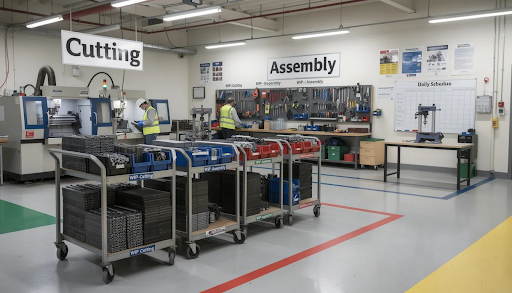
The shift to production requires rethinking your shop layout around a forward-moving, linear workflow. Raw material comes in at one end, moves through defined stations, and ships out the other side. Even in a small footprint under 3,000 sq ft running CNC mills and routers with manual finishing and simple assembly, this principle applies.
Start by creating “micro-zones” within your existing space: separate areas for material prep, CNC machining operations, deburr and finishing, inspection, and shipping. These zones don’t need walls or major renovations—even tape on the floor and labeled shelving creates structure. The goal is ensuring that every batch follows a standard route, so work flows predictably instead of bouncing between random benches.
Practical aids make this workflow real. Labeled racks for work-in-progress (WIP) prevent parts from getting lost between operations. Dedicated carts per job keep all components, travelers, and documentation together as work moves through the shop. Standard routes posted visibly remind everyone where parts go next, which becomes critical as volumes ramp up and multiple jobs run simultaneously.
Simply Technologies can help map your current process steps—from CAD/CAM through machine time to shipping—and design a low-friction workflow tuned to short-run production rather than one-off prototyping. This isn’t about installing an assembly line; it’s about creating enough structure that a 3–6 person team can handle 10–20 active jobs without confusion.
3. Standardizing Process and Quality: From “It Works” to “It Works Every Time”
Production customers in 2024–2025 expect consistent quality and traceability even from small shops. The aerospace company ordering 200 brackets doesn’t care that you’re a four-person operation—they care that every bracket meets spec and you can prove it.
This means moving from tribal knowledge to written processes. Document the critical information that currently lives in your experienced machinists’ heads:
- Operation sheets that list each step in sequence, with specific parameters
- Setup checklists covering workholding, tool positions, offsets, and program names
- Inspection plans tied to specific part numbers and revision dates
Lightweight quality control systems work well for small shops. You don’t need full ISO 9001 certification to run professionally, but adopting ISO-inspired practices makes a significant difference. Keep controlled drawings in a single location (not scattered across personal folders). Maintain revision logs showing what changed and when. Track non-conformances through basic NCR reports so problems get fixed instead of repeated.
Concrete inspection checkpoints structure this work. First-article inspection on the first piece of each batch catches setup errors before you’ve made 100 bad parts. In-process checks every defined quantity (such as every 20 parts) catch tool wear and process drift. Final inspection before packing provides the last verification that what ships matches what was ordered.
Measuring tools should be standardized and calibrated. By 2025, most small CNC or fabrication shops should have calibrated calipers, micrometers, height gauges, and go/no-go gauges for recurring features. When everyone uses the same tools and techniques, measurement variation drops and customer disputes decrease.
Simply Technologies provides templates for travelers, inspection sheets, and digital logs so a 3–6 person team can maintain traceable quality without hiring a full-time quality manager. These aren’t academic exercises—they’re practical documents that fit into daily work.
4. Tooling, Fixtures, and CNC Strategy for Repeatable Production
Tooling investment separates prototype shops from production operations. When you’re running a part once, it makes sense to use general-purpose workholding and whatever tools are handy. When you’re running the same part quarterly at 200–300 pieces, dedicated fixtures and standardized tooling pay dividends in cycle time reduction and consistency.
The breakeven point arrives sooner than most shops expect. When a part runs more than 3–4 times per year or exceeds 200–300 pieces annually, a simple aluminum fixture or vacuum jig often pays back within a few months. Calculate the setup time savings across the year: if a dedicated fixture saves 30 minutes per batch and you run 8 batches, that’s 4 hours returned to productive machine time.
Standardized tooling libraries inside CAM software multiply these benefits. Create consistent tool numbers, diameters, and holder definitions so programs are reusable across jobs and years. When tool #15 always means a 12mm carbide end mill with the same stickout and speed/feed parameters, programming becomes faster and more reliable.
Specific tools worth standardizing for a small CNC business by 2024–2025 include common carbide end mills (6mm and 12mm cover most work), 90° chamfer mills, and standard drill sizes that appear repeatedly in your parts. Locking in these choices reduces program edits, setup variability, and the risk of human error from grabbing the wrong tool.
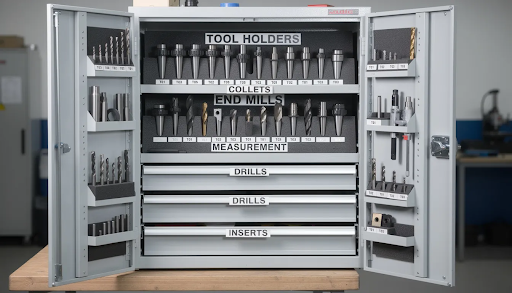
Tool staging at the machine matters as much as tool selection. A dedicated tooling cart or cabinet next to each CNC with pre-set holders and labeled locations for common tools minimizes changeover time between jobs. Operators shouldn’t spend 15 minutes hunting through drawers for the right collet—everything needed for common jobs should be visible and accessible.
Simply Technologies can analyze your real production data—cycle times, scrap rates, setup duration—to recommend where you should first invest in fixturing or tooling. This data-driven approach ensures limited capital goes toward improvements that directly increase throughput and reduce cost per part.
5. Data, Scheduling, and Traceability Built for a Small Shop
Small shops moving to production in 2024–2025 need simple but reliable digital tracking. Spreadsheets scattered across laptops worked when every job was custom, but production work demands better organization. Customers ask questions—which batch did my part come from, what material heat lot was used, who signed off inspection—and you need answers.
Job tracking starts with basics: unique job numbers, start and finish dates, quantities launched and completed, scrap counts, and operator notes recorded consistently for each production run. This information doesn’t require expensive software. A well-designed spreadsheet or simple database works, as long as everyone uses it consistently.
Scheduling for small teams should match the scale. Visual boards work well: magnetic strips or cards showing what’s on each machine for the next 1–2 weeks. Simple digital dashboards accessible from a shop tablet provide the same visibility with easier updates. The goal isn’t sophisticated planning algorithms—it’s making sure the next two weeks are clear to everyone and potential customers have realistic delivery expectations.
Traceability at this scale means being able to answer customer questions without a full ERP system. Can you identify which batch a delivered part came from? Which material heat lot was used? Who inspected it and when? These questions come up during customer audits and quality investigations. Building traceable records now prevents scrambling later.
Simply Technologies can integrate with your existing CAD/CAM and CNC ecosystem, adding layers for order tracking, revision control, and reporting without forcing a complete software replacement. The approach focuses on capturing real production metrics—on-time delivery rate, first-pass yield, setup time per job—so your shop can make data-driven decisions about pricing and capacity expansion.
Encourage capturing these metrics as standard practice by mid-2020s standards. When you can show potential customers that your on-time delivery rate exceeds 95% and your first-pass yield runs above 98%, you’re competing on demonstrated capability rather than promises.
6. Partnering With Simply Technologies to Scale From First Run to Steady Production
Simply Technologies focuses specifically on bridging the gap between early prototypes and reliable production for small CNC, machining, and fabrication shops. The consulting and digital tools are tailored to teams of roughly 2–20 people—large enough to need structure, small enough that enterprise solutions are overkill.
The support covers the full range of transition challenges. Workflow and layout reviews identify bottlenecks and wasted motion in your current setup. CNC program and tooling standardization ensures that your machine time produces consistent results. Documentation templates—travelers, inspection sheets, revision logs—give your team production-grade records without creating administrative burden. Implementation support for simple scheduling and tracking systems keeps everyone aligned without requiring IT expertise.
Consider a scenario from 2023–2025: a shop handling irregular prototype orders for various industries realizes that several parts have become recurring. Orders that were once 10–20 pieces are now 100–200 pieces quarterly. Simply Technologies helps redesign fixtures for the high-volume parts, formalize inspection routines with first-article and in-process checks, and implement job tracking that satisfies customer audit requirements. Within 6 months, the shop operates with production-grade reliability while maintaining the flexibility that attracted their original customers.
Think of Simply Technologies not just as a software vendor but as a long-term technical partner. The team understands the realities of short-run manufacturing—the pressure of lead times, the challenge of customer audits, the need to reduce cost without sacrificing quality. Whether you’re sourcing materials for your first production run or optimizing an established supply chain, this partnership grows with your business.
The manufacturing industry rewards shops that can reliably produce prototypes and scale into production. Many businesses get stuck in prototype mode, unable to capture the recurring revenue that production work offers. Simply Technologies helps you cross that bridge—building the processes, tools, and data systems that turn a capable prototype shop into a dependable production partner.
FAQ
When should a small shop stop treating a part as a prototype and start treating it as a production job?
This transition typically happens once design revisions slow down and the same part is ordered multiple times at volumes of 50–500 units, often spanning at least 6–12 months of recurring demand. At this point, it becomes both cheaper and safer to invest in dedicated fixtures, formal documentation, and systematic quality control. Continuing to treat high-volume repeat parts as prototypes means absorbing unnecessary setup time and accepting inconsistent results that eventually damage customer relationships.
How much investment is typically needed to move from prototyping to small-batch production?
Realistic ranges for 2024–2025 start at a few thousand dollars for basic fixtures, improved gauging, and shop organization—enough to handle low volume production professionally. More significant investments reach tens of thousands of dollars when adding new machines, advanced inspection equipment, or comprehensive digital tracking systems. Simply Technologies can help prioritize investments that directly improve throughput and reliability, ensuring limited capital goes where it generates the largest return rather than toward nice-to-have improvements.
Do we need ISO 9001 certification to run production work for customers?
Many small shops successfully run production without formal ISO certification, particularly when serving local or regional customers in various industries. However, adopting ISO-inspired practices—controlled documents, traceable inspections, revision management—provides most of the quality benefits without the certification overhead. Formal certification becomes more important when serving aerospace, medical devices, or automotive sectors where customer audits explicitly require it. Simply Technologies helps implement ISO-aligned practices that satisfy demanding customers while keeping administrative burden appropriate for small teams.
How long does it take to build a stable production process from an existing prototype?
Simple parts with stable design can often be production-ready within 3–6 months, including fixture development, documentation, and a few proving runs. More complex assemblies or parts requiring multiple operations may take 9–12 months to fully stabilize, incorporating lessons learned from multiple low-volume production runs. Simply Technologies helps compress this timeline by front-loading process design and data collection, identifying potential issues before they become expensive problems during your first production run.
Can a 2–3 person shop realistically manage production-grade documentation and quality control?
Absolutely. Small teams succeed by using lightweight, standardized templates, clear naming conventions, and simple digital tools instead of heavy enterprise systems. The key is making documentation part of the daily routine rather than a separate administrative burden. Simply Technologies provides ready-to-use forms and workflows specifically tailored to small teams—travelers that take seconds to fill out, inspection sheets integrated with existing measurement practices, and digital logs that don’t require dedicated IT support. When done right, a few hours per week maintains production-grade traceability.