
Key Takeaways
- Entry level cnc routers (typically $1,000–$15,000) are designed for learning, prototyping, and light commercial work with duty cycles of 1–4 hours per day, while production machines ($40,000+) are engineered for multi-shift, 24/7 industrial output
- The core differences extend far beyond spindle power and table size—frame rigidity, servo vs stepper motors, closed-loop control systems, automatic tool changers, and vacuum hold-down systems separate the categories fundamentally
- Tolerance capabilities differ significantly: entry-level machines typically achieve ±0.1–0.3mm accuracy, while production routers maintain ±0.02–0.05mm repeatability across thousands of parts
- Choosing an entry-level router when you need production capacity leads to missed deadlines, poor tolerances, and high scrap rates; overspecifying a production machine for hobbyist projects wastes capital that could be deployed elsewhere
- Simply Technologies focuses on helping shops evaluate their actual requirements and move from entry-level equipment to production-class systems with real ROI calculations—not just selling bigger machines
Introduction: Why “Entry Level” vs “Production” Really Matters
Many buyers focus on spindle power and table size when comparing cnc machines, but these surface-level specs hide deeper structural and control differences that determine whether a machine can actually deliver consistent results under real workloads.
An entry level cnc router typically refers to benchtop or lightweight gantry machines with 2×3 ft to 4×4 ft tables, hobby or prosumer pricing, and construction optimized for affordability rather than continuous operation. A production cnc router, by contrast, features heavy gantry or bridge construction, 4×8 ft tables and larger, industrial controls, and engineering designed for multi-shift operation without degradation.
Consider the typical applications: entry-level machines handle MDF signage, light cabinet door prototyping, and foam mockups well enough. Production routers tackle high-volume cabinet shops processing 40+ sheets daily, aerospace composite trimming, and aluminum tooling boards requiring extreme precision across thousands of identical parts.
Simply Technologies specializes in helping growing shops evaluate when their current entry-level router is enough—and when the limitations are costing more in missed orders, overtime, and scrap than an upgrade would require. Through https://simplytechnologies.xyz/, shops can access structured guidance on making this transition based on real production data rather than sales pressure.
The rest of this article breaks down the technical differences—rigidity, accuracy, duty cycle, automation, software, and lifecycle cost—using practical, business-focused language that helps you make informed decisions.
What Counts as an Entry Level CNC Router Today?
In 2024, entry level cnc routers span a price range from approximately $1,000 to $10,000, with table sizes ranging from the compact 300×180mm “3018” class up to 4×4 ft gantry machines. Build materials typically include aluminum extrusions, MDF or composite beds, and light welded steel frames designed to minimize manufacturing cost.
Common hardware traits across this category include:
| Component | Typical Entry-Level Specification |
| Spindle | Trim router or 0.8–2.2 kW air-cooled ER11/ER16 |
| Frame | Aluminum extrusion or light welded steel |
| Motion | Belt drive or light-duty lead screws |
| Motors | Stepper motors without closed-loop feedback |
| Controller | GRBL or Mach-compatible hobby boards |
| Power | Single-phase 110V or 220V |
The typical performance envelope of these machines allows acceptable accuracy for woodworking and plastics—generally ±0.1–0.3mm—with limited feed rates in hardwoods and severely constrained performance when cutting aluminum or other nonferrous metals. Attempting to push feed rates too high results in chatter, dimensional drift, or lost steps.
Target users include hobbyists working on hobbyist projects, schools teaching cnc technology fundamentals, makerspaces offering community access to computer numerical control equipment, prototype labs iterating designs quickly, and small craft businesses running a few hours per day rather than multi-shift production.
Simply Technologies often sees customers who started with a 3018-style desktop router or a 4×4 hobby gantry and now need something that can hold tight tolerances and run all day without constant recalibration and tweaking.
What Defines a Production-Class CNC Router?
Production routers are engineered from the ground up to run 8–24 hours per day in professional environments: cabinet factories, sign production facilities, aerospace shops, and OEM manufacturing cells where downtime directly translates to lost revenue.
Typical specifications for production-class equipment include:
| Component | Production-Class Specification |
| Frame | Heavy welded steel or cast iron base |
| Table Size | 4×8 ft, 5×10 ft, or larger |
| Spindle | 6–15 kW ISO or HSK taper, high quality bearings |
| Motors | Servo-driven with encoders |
| Motion | Helical rack-and-pinion or precision ball screws |
| Controller | Industrial CNC with look-ahead, jerk control |
| Power | Three-phase 208–440V |
Quantifiable performance differences become apparent immediately: production machines maintain tighter and more repeatable tolerances (±0.02–0.05mm on wood and plastics), achieve high acceleration and rapid speeds without sacrificing accuracy, and deliver consistent performance across long production runs and multi-shift use without thermal drift or mechanical degradation.
Key integrated features that are often standard or common on production routers include automatic tool changers (ATC), vacuum hold-down tables with zoned control, material alignment stops and pop-up pins, probing systems for automatic tool length measurement, and safety enclosures or light curtains meeting industry standards.
Simply Technologies focuses on matching these production-class capabilities to each shop’s specific workflow—whether that’s nested-based manufacturing for cabinet components, panel processing for furniture production, or composite trimming for aerospace applications—rather than selling a generic “big router” that may not fit the actual work.
Mechanical Design and Rigidity: The Foundation of Accuracy
Rigidity—encompassing frame, gantry, and linear motion stiffness—is the primary physical difference between entry-level and production routers. This single factor directly impacts surface finish, tool life, achievable feed rates, and the ability to produce high quality parts consistently.
Entry-level designs typically feature:
- Lightweight gantries that flex under cutting loads
- Aluminum extrusion frames with inherent compliance
- V-wheel carriages or small linear rail systems
- Belt drives that stretch under tension
- Insufficient mass to dampen vibration
These characteristics contribute to deflection under load and vibration at higher cutting forces, limiting the materials and speeds the machine can handle without quality degradation.
Production router construction takes a fundamentally different approach:
- Thick steel or cast-iron bases providing mass and damping
- Wide-spread linear guideways resisting moment loads
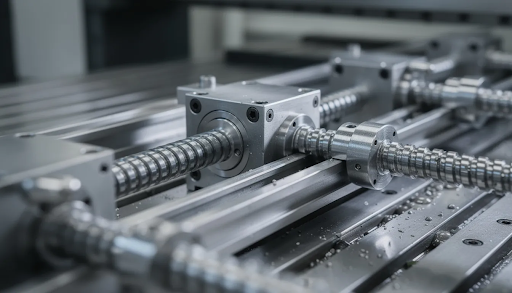
- Helical rack-and-pinion or high-precision ball screws
- Engineered gantry cross-sections to resist twisting and bending
- Robust construction throughout the motion system
The practical difference becomes obvious in operation. Cutting 18mm birch plywood at 3 m/min on an entry-level router may produce acceptable results, but pushing to 6 m/min often causes chatter and dimensional error. A production machine running the same material can achieve 10–15 m/min or more with a clean edge and repeatable dimensions—because the machine bed and gantry don’t deflect under the increased cutting forces.
Increased rigidity also enables heavier spindles, more aggressive tooling like compression bits in cabinet production, and deeper passes that would stall or flex an entry-level machine. This translates directly to reduced production time and higher output per shift.
Spindles, Motors, and Motion Control
Cutting quality and consistency emerge from the combination of spindle power and bearings, drive motors, and control electronics working together. Weaknesses in any component limit the entire system’s capability.
Entry-level hardware typically includes:
- Trim routers or small ER11 spindles under 1.5–2.2 kW
- Stepper motors operating open-loop without position feedback
- Simplified hobby controller boards with limited I/O
- No advanced diagnostics or error detection
- Basic motion planning without look-ahead optimization
Production-class setups incorporate:
- 6–15 kW ISO or HSK taper spindles with precision bearings
- Servo motors with absolute or incremental encoders
- Industrial CNC controls offering look-ahead processing
- Jerk control for smooth acceleration without vibration
- High speed spindle capability with automatic speed control
The practical consequences of these differences show up daily. Entry-level routers may lose steps if pushed too hard, causing parts to drift out of tolerance. They can also experience thermal expansion effects during long runs and struggle to maintain consistent depth of cut across the z axis. Production machines maintain exact position across thousands of parts in a shift through closed-loop feedback that corrects any deviation before it becomes a defect.
Simply Technologies helps customers specify spindle power, tool interfaces, and servo packages based on actual material stacks—for example, 2× 18mm MDF plus laminate—and planned feeds and speeds rather than generic “more power is better” advice that leads to over- or under-specification.
Throughput, Duty Cycle, and Real-World Production Capacity
Duty cycle (how many hours per day a machine can reliably run) and throughput (parts per shift) are where the business difference between entry-level and production routers becomes obvious—and where the financial case for upgrading often becomes clear.
Realistic duty cycle ranges differ substantially:
| Machine Class | Comfortable Daily Runtime | Multi-Shift Capability |
| Entry-Level | 1–3 hours with cool-down | Not recommended |
| Prosumer | 3–6 hours with breaks | Limited, warranty concerns |
| Production | 8–24 hours continuous | Designed for 5–7 day/week operation |
Consider a concrete scenario: a small cabinet shop cutting 10–15 sheets of 18mm plywood per week might manage with an entry-level router, accepting slower speeds and more operator time. A shop processing 40–80 sheets per day needs a vacuum table for efficient hold-down, an ATC for drilling operations and different bit profiles, and robust drives to operate continuously without overheating.
Higher feed rates, reduced setup times, and reliable unattended cutting cycles on a production machine convert directly into more billable output per square meter of floor space. When machines can operate continuously through a shift while the operator handles other tasks, labor costs per part drop dramatically.
Simply Technologies often helps customers build simple spreadsheets tracking current parts per hour, scrap rate, and labor hours, then model how a production router changes those numbers over 3–5 years. The results frequently show that increased efficiency and throughput justify the investment faster than expected.
Automation and Workflow Integration
The presence or absence of automation—tool changers, probing, loading aids—is one of the clearest dividing lines between entry-level machines and true production routers designed for industrial manufacturing.
Entry-level workflows typically involve:
- Single manual tool changes requiring program stops
- Manual zeroing with paper or touch plates
- Hand clamping workpieces for each part
- Manual labeling and sorting after cutting
- Significant non-cutting time between operations
Standard or common automation on production machines includes:
- ATC carousels or linear magazines holding 8–24+ tools
- Automatic tool length measurement and compensation
- Vacuum pods or zoned vacuum tables
- Pop-up pins for sheet alignment and registration
- Integrated code for label printing or part tracking
- Probing systems for automatic workpiece location
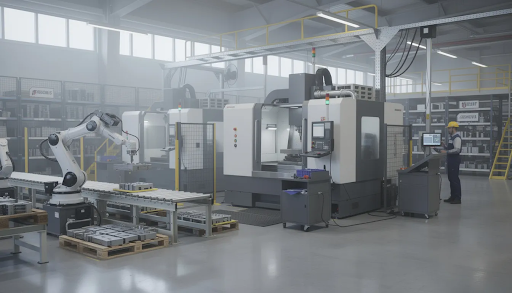
These systems reduce human error in tool setup and part location, speed up changeovers between jobs, and make nested-based manufacturing of large sheet goods economically viable. A capable machine with proper automation can process complex parts from multiple materials without operator intervention for each tool change.
Simply Technologies works with customers to map their entire workflow from cad and cam software nesting through offloading and finishing, ensuring the cnc router’s automation matches their production style instead of becoming an unused feature.
Software, Controls, and Ease of Use
While both entry-level and production routers run G-code generated by cam software, the control ecosystems around them differ significantly in stability, capability, and long-term support.
Entry-level setups typically feature:
- GRBL- or Mach-based controllers
- Open-source or low-cost CAM programs
- Operation from USB stick or laptop
- More manual parameter settings
- Fewer built-in crash protections
- Limited I/O for automation integration
Industrial controls offer:
- Dedicated CNC control panels with handwheels
- Industrial HMIs with intuitive controls
- Comprehensive alarm and diagnostic systems
- Backup and restore features for programs and settings
- Strong support for 3D contouring and high-speed smoothing
- Multiple axes interpolation for complex shapes
Software integration extends beyond the machine itself. Production routers typically link tightly to nesting software, ERP systems, and barcoding for production tracking, enabling manufacturing operations to flow smoothly from order entry through shipping. Entry-level machines are more stand-alone, suitable for one-off work or low-volume production but limiting as volumes grow.
Computer aided design files flow through computer aided manufacturing software to generate toolpaths, and the quality of this chain affects final part quality. Simply Technologies helps select control and CAM combinations that align with each customer’s skill level, IT environment, and file formats—whether that’s cabinet design packages, DXF workflows, or standardized post-processors for specific controls.
Total Cost of Ownership: When Upgrading Pays Off
The sticker price of a cnc mill or router is only one part of the financial picture. Maintenance, scrap, operator time, and uptime must be considered over 3–10 years to understand true cost of ownership.
Entry-level routers present a typical financial profile:
- Low initial cost ($1,000–$15,000)
- Minimal installation requirements
- Higher operator involvement for setup and monitoring
- More frequent tinkering and small breakdowns
- Earlier replacement when pushed beyond design limits
- Limited reducing downtime through preventive maintenance
Production-router economics differ substantially:
- Higher upfront investment ($40,000–$150,000+)
- Installation costs for power, dust collection, and training
- Much lower cost-per-part due to faster cutting
- Lower scrap from consistent precision machining
- Longer machine life at 24/7 loads
- Increasing productivity through automation and speed
Consider a practical comparison: a shop producing 200 cabinet doors per month on an entry-level router operates with high labor hours and frequent overtime to meet deadlines. The same shop with a production router from Simply Technologies might produce 2,000+ doors monthly, with labor hours per door cut by 60–80% through faster processing and reduced manual intervention.
Simply Technologies supports ROI analysis including financing options, projected payback time (often 12–36 months in busy shops), and risk assessment. This allows owners to justify the leap from entry-level to production hardware with real numbers rather than hope.
How to Decide: Are You Ready to Move Beyond Entry Level?
Not every user needs a production machine. This section helps you assess whether your situation calls for an upgrade—or whether your current equipment still fits your requirements.
Clear triggers indicating it may be time to upgrade:
- Consistently running more than 4–6 hours per day
- Struggling to keep up with orders despite working overtime
- Quality issues when attempting higher speeds
- Frequent maintenance interruptions affecting delivery
- Customer requirements for tighter tolerances you can’t meet
- Need for reliable aluminum or composite cutting performance
- Projects requiring complex operations beyond current capability
Non-technical constraints to evaluate:
- Available power (three-phase supply may require electrical work)
- Shop floor space for larger machine footprint
- Dust collection capacity for higher chip loads
- Staffing and training readiness for advanced machines
- Capital availability or financing options
A practical approach involves creating a simple comparison:
| Factor | Current State | Target State |
| Parts per day | ? | ? |
| Materials processed | ? | ? |
| Required tolerances | ? | ? |
| Daily runtime | ? | ? |
| Acceptable scrap rate | ? | ? |
Compare these requirements against the technical capabilities of your current entry-level router. If the gaps are significant, upgrading becomes a business necessity rather than a luxury.
Simply Technologies can review this information, discuss concrete machine options and configurations, and provide guidance via consultation through https://simplytechnologies.xyz/ without pressure to buy prematurely. The goal is ensuring any investment actually addresses your constraints.
How Simply Technologies Helps You Bridge the Gap
Simply Technologies operates not just as a machine supplier, but as a technology partner focused on moving customers from hobby or prototype stages into sustained, efficient production with cnc routers that match actual requirements.
Specific services include:
- Application review: Analysis of materials, part sizes, and annual volumes to determine appropriate machine specifications
- On-site or remote assessments: Evaluation of existing routers to identify specific limitations and upgrade priorities
- Specification recommendations: Guidance on machine specs, tooling, fixturing, and software workflows tailored to your work
- Integration planning: Ensuring new equipment connects properly with existing cad and cam software and shop systems
Simply Technologies can propose phased upgrades—for example, moving from a single entry-level router to a small production router, then to fully automated cells—allowing shops to spread investment over time as revenue grows. This approach avoids the financial strain of big projects while building toward full production capability.
Training and after-sales support ensure that the new production-class router actually delivers its promised performance. Operator training, maintenance guidance, and remote diagnostics help teams safely run at production speeds without damaging end mills, materials, or the machine itself. Skilled operators working with best cnc equipment achieve manually impossible consistency.
If you feel “stuck” with your current entry-level router—hitting capacity limits, struggling with quality at speed, or losing orders to shops with better equipment—contact Simply Technologies via https://simplytechnologies.xyz/ for a structured discussion about realistic upgrade paths and projected ROI.
FAQ
The following questions address common concerns not fully covered in the main sections, especially from users currently operating entry-level routers and evaluating whether a production upgrade makes sense for their situation.
How much should I budget to move from an entry-level router to a production machine?
Shops moving from hobby or prosumer routers into serious production typically invest anywhere from approximately $40,000 to well over $150,000 depending on table size, spindle power, automation level, and tooling packages. This range reflects the difference between a basic 4×8 ft production router and a fully automated cell with ATC, vacuum hold-down, and integrated nesting software.
Simply Technologies helps customers build multi-year budgets that include not only the machine, but also dust collection upgrades, electrical work for three-phase power, training, and initial tooling—ensuring no hidden surprises after purchase. For growing businesses, financing or leasing options can align monthly payments with increased revenue from higher throughput, making the transition more manageable.
Can I use my existing entry-level CNC router alongside a new production machine?
Many shops keep their entry-level router as a secondary station for engraving, face mills testing, jigs, prototypes, or low-priority diy machines projects while moving high-volume cutting and precision parts to the new production router. This approach is common in shops transitioning between capability levels.
This can be a cost-effective way to increase total capacity, using the production machine as the workhorse for intricate designs and high accuracy requirements while the old router handles flexible or experimental work. Simply Technologies can help plan how to divide work between machines to maximize overall throughput and minimize changeovers on the production system.
Do I need three-phase power for a production-class CNC router?
Most true production routers with larger spindles and vacuum pumps are designed for three-phase power operating at 208–440V. However, small-to-mid production systems can sometimes run on single-phase with derated spindle performance or phase converters, though this is generally not recommended for continuous operation.
Upgrading electrical service is often part of transitioning from entry-level to production equipment and should be factored into budget and timeline early in the planning process. Simply Technologies can review site conditions and coordinate with local electricians to ensure the power infrastructure supports the chosen machine configuration safely and meets all applicable codes.
How long does it take to get operators up to speed on a production router?
Operators familiar with entry-level routers and basic cnc software can usually become productive on a new production machine within a few days of focused training, though mastering advanced machines features—such as optimizing feeds and speeds for tougher materials, using probing cycles, and managing ATC sequences—may take several weeks of real-world use.
Modern industrial controls and nesting software are designed to be operator-friendly with intuitive controls, and good training significantly shortens the learning curve while reducing the risk of crashes or tool breakage. Simply Technologies provides structured training sessions and follow-up support so teams can safely run at production speeds, handling intricate pieces and complex projects without damaging tools or material.
Is it worth buying a used production router instead of a new one?
A used production router can be a good step up from entry-level machines if its mechanical condition, control system age, and support availability are carefully evaluated in advance. Used machines from various industries may have been well-maintained or may be approaching end-of-life on critical components.
Older controls, worn linear guides, or obsolete electronics can lead to unexpected downtime and expensive retrofits, potentially negating any initial savings. The x axis, y and x and y axes, and z axes all require inspection for wear that affects high precision capability. Simply Technologies can advise on whether a specific used machine represents a smart investment, or whether a new or factory-refurbished router with warranty will offer better long-term return on investment for your manufacturing operations.