
Key Takeaways
- CNC education for students delivers job-ready skills in programming, setup, and operation that modern factories use every day across automotive, aerospace, medical, and consumer product sectors.
- Hands on training on industrial-grade cnc equipment is essential for employability in the 2024–2030 manufacturing landscape, where skilled technicians are in high demand.
- Simply Technologies focuses on real-world projects, safety protocols, and industry-standard workflows to bridge the gap between school and factory floors.
- Graduates can move into roles like CNC operator, junior programmer, and production technician with clear paths for advancement into engineering, supervision, and even starting their own business.
- Understanding cnc programming and cad cam workflows early prepares students for Industry 4.0 technologies and connected manufacturing environments.
The manufacturing industry is transforming, and computer numerical control machines sit at the center of that shift. For students considering a career in this field, the question is no longer whether CNC skills matter—it’s how quickly they can acquire them. This guide breaks down exactly how CNC-focused education prepares young learners for real jobs in precision manufacturing, from the first day of training to their first week on a production floor.
Why CNC Skills Matter in Today’s Manufacturing Industry
Global manufacturing in 2024 depends on CNC technology for precision, speed, and automation at scales that manual machining operations simply cannot match. Every sector—from automotive suppliers to aerospace contractors—relies on these machines to produce parts with consistent quality, tight tolerances, and minimal human error.
CNC machines handle milling, turning, drilling, and cutting across industries that touch nearly every aspect of modern life. Automotive manufacturers use CNC lathes and machining centers to produce engine components and transmission parts. Aerospace companies rely on multi-axis CNC mills to shape complex brackets and structural elements. Medical device makers turn to precision cnc machine centers for implants and surgical instruments. Consumer product companies use CNC equipment for everything from smartphone housings to kitchen appliance components.
Consider a CNC-milled aerospace bracket that requires tolerances within ±0.01 mm and must maintain that level of precision across thousands of identical parts. Manual machining cannot deliver this repeatability. A medical implant, such as a titanium hip joint component, demands the same consistency—each piece must be virtually identical to pass quality control inspections before it ever reaches a patient.
Digital manufacturing workflows have become standard practice in modern factories. A typical production job now flows from a computer aided design model through CAM software that generates toolpaths, which are then converted into g code instructions that the CNC controller executes. This chain—CAD to CAM to CNC—represents the foundation of contemporary machining operations.
The demand for skilled CNC technicians and programmers is growing as the current workforce retires. Between 2025 and 2035, manufacturers across North America and Europe face significant labour shortages in skilled trades. Students who understand CNC concepts early are better prepared for Industry 4.0 technologies, including connected machines, real-time monitoring systems, and data-driven production optimization.
What Students Learn in CNC-Focused Education
A comprehensive CNC curriculum covers theory, practice, and professional skills that translate directly to factory floors. The courses provide structured progression from basic concepts to advanced machining operations.
Core theoretical knowledge includes:
- Coordinate systems: Cartesian coordinates, absolute positioning, and work coordinate systems that define where cutting happens relative to the workpiece
- Axes of motion: Understanding X, Y, Z linear axes plus rotary axes (A, B, C) used on multi-axis machines
- Feeds and speeds: Calculating appropriate cutting parameters based on material type, tool geometry, and machine capabilities
- Safety protocols: Lockout/tagout procedures, proper handling of coolants and chips, and emergency stop procedures
Foundational machine operations build systematically:
Students typically start with manual machining fundamentals on conventional mills and lathes. This foundational work helps them understand how metal-cutting actually works—the physics of chip formation, the feel of proper tool engagement, and the sounds that indicate good versus problematic cutting conditions. From there, they progress to CNC mills, CNC lathes, and eventually to simple multi-axis machines and turning centre equipment.
Specific technical training covers:
- Reading engineering drawings and understanding GD&T (Geometric Dimensioning and Tolerancing) symbols
- Selecting cutting tools appropriate for specific operations—end mills, face mills, drills, boring bars, and specialized tooling
- Choosing appropriate materials such as aluminum 6061, mild steel, stainless steel, and engineering plastics
- Understanding tool life factors and when to replace worn cutting tools
Introduction to programming includes:
| Concept | Description | Application |
| G-code | Preparatory commands for motion and positioning | G01 for linear interpolation, G02/G03 for arcs |
| M-codes | Miscellaneous functions for machine control | M03 for spindle on, M08 for coolant on |
| Tool offsets | Compensation values for tool length and diameter | Ensuring accurate part dimensions |
| Work offsets | Defining the zero point for machining operations | G54-G59 work coordinate systems |
| Canned cycles | Pre-programmed routines for common operations | Drilling cycles, tapping cycles |
| Subprograms | Reusable code blocks for repeated features | Reducing program complexity |
Modern CNC education integrates cad cam software to generate toolpaths from 3D models. Students learn to simulate tool motion, check for collisions between cutting tools and fixtures, and verify code before sending it to the machine. Platforms like Autodesk Fusion 360 and Mastercam are commonly used to teach these complete digital workflows.
Soft skills embedded in CNC education are equally important: problem-solving when parts don’t meet specifications, attention to detail when reading prints, time management when balancing multiple job orders, and clear communication on a busy shop floor.
How Simply Technologies Connects CNC Education to Real Jobs
Simply Technologies designs its technical training paths around actual factory workflows used in small and mid-sized job shops as well as high-volume production plants. The focus is practical, industry-aligned education that prepares students to contribute from their first day on the job.
Students work with industrial-style equipment and digital tools that mirror what they will encounter in production environments. This includes production-grade CNC machining centers, lathes with modern control interfaces, and metrology equipment used for part inspection. The learning environment replicates the look, feel, and pace of professional manufacturing.
Learning modules follow the complete life cycle of an actual job order:
- Interpreting the customer drawing – Reading prints, identifying critical dimensions, and understanding tolerances
- Choosing tools and fixtures – Selecting appropriate cutting tools and workholding based on part geometry and material
- Programming – Writing or generating code that produces the required features
- Running a first article – Machining the initial part with careful attention to setup accuracy
- Inspecting parts – Using calibrated instruments to verify dimensional accuracy
- Documenting results – Recording setup details, inspection data, and any process adjustments
Simply Technologies emphasises safe machine operation, including lockout/tagout concepts, proper handling of coolants and chips, and compliance with whmis regulations for hazardous materials. These practices meet real safety expectations that potential employers require.
The company’s content and labs are designed to make the first week of a new job feel familiar to students. When graduates arrive at their new workplace, they recognize the control interfaces, understand the workflow expectations, and can communicate effectively with experienced machinists. This reduces training time for employers and accelerates the path to productivity.
Simply Technologies frequently updates learning content to reflect changes in CNC controls, tooling technology, and digital manufacturing trends. This ensures students learn current practices rather than outdated methods.
From Classroom to Shop Floor: Hands-On CNC Training
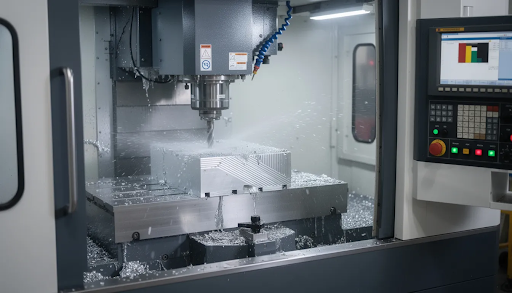
Hands on training matters more than theory alone. Students can memorize g code syntax and understand coordinate systems conceptually, but the skills that get them hired come from actual machine time under realistic conditions.
Progressive lab work builds confidence systematically:
Early sessions focus on basic machine operations: powering up the cnc machine correctly, performing reference returns to establish home positions, jogging axes manually, and loading simple programs under instructor supervision. Students develop muscle memory for control interfaces and learn to move deliberately around operating machinery.
Practice projects develop core competencies:
| Project | Skills Developed | Typical Materials |
| Milling an aluminum cube with reference faces | Squaring stock, face milling, establishing datums | Aluminum 6061 |
| Turning a stepped shaft | OD turning, facing, groove cutting | Mild steel |
| Machining a fixture plate with hole patterns | Drilling cycles, coordinate programming | Aluminum or steel |
| Multi-feature bracket | Pocket milling, contour milling, hole operations | Various |
Students should complete at least one small production-style run—machining 20 to 50 identical parts—to experience setup reduction, cycle times optimization, and quality checks at scale. This exercise reveals the difference between making one good part and making fifty good parts efficiently. Students learn to reduce waste through proper planning and process control.
Measurement and inspection are integral:
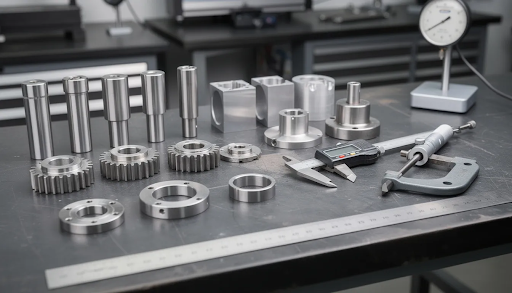
Every hands-on session incorporates verification using calipers, micrometers, height gauges, and digital inspection reports. Students learn that machining a part is only half the job—proving it meets specifications completes the work. Understanding quality control processes prepares them for inspection responsibilities they will encounter in any manufacturing role.
Documentation practices mirror professional standards:
Students document setups with photos, notes, and setup sheets. This practice teaches them to hand off work between shifts, a common requirement in factories running multiple shifts. When the next operator can replicate a setup from documentation alone, production continues smoothly.
Instructors simulate real shop-floor issues:
Experienced instructors introduce controlled problems—chatter from improper cutting parameters, tool wear that causes dimensional drift, or fixturing issues that affect part accuracy. Students practice troubleshooting live jobs rather than only working with ideal conditions. This expertise in problem identification and resolution is exactly what employers seek.
Key CNC Competencies That Employers Look For
Job descriptions from manufacturers in 2023–2025 consistently identify specific competencies that separate hireable candidates from those who need additional training. Understanding what employers want helps students focus their learning on high-value skills.
Core technical competencies include:
- Safe operation of CNC mills and lathes without supervision
- Reading and editing basic g code to correct minor issues
- Selecting appropriate cutting tools for common operations
- Managing tool offsets to maintain dimensional accuracy
- Translating job travelers or work orders into machine-ready operations
Advanced competencies that students can begin developing:
- Multi-axis machining strategies for complex geometries
- Basic fixture design to improve workholding efficiency
- Simple macro programming for parametric operations
- Working with difficult materials like hardened steel or titanium alloys
Employers value candidates who can read and understand CAD drawings, identify critical dimensions versus reference dimensions, and ask clarifying questions before machining. A student who catches a missing tolerance callout before cutting metal saves the company time and material.
Workplace skills matter as much as technical skills:
- Showing up reliably and on time
- Maintaining a clean, organized work area following 5S principles
- Entering basic production data into digital tracking systems
- Communicating effectively with supervisors and coworkers
Employers increasingly appreciate familiarity with networked machines, digital job tracking screens, and basic data collection from CNC controls. Manufacturers running modern shops expect operators to interact with digital systems, not just mechanical controls.
Simply Technologies structures exercises so students can demonstrate these competencies through portfolios and interview preparation. When a student can show documented evidence of production runs, inspection records, and troubleshooting examples, they stand out in the job market.
Career Paths for Students with CNC Training
CNC skills open doors to a range of career progressions over 3 to 10 years. The path from entry-level operator to skilled technician to leadership or ownership is well-established in manufacturing.
Entry-level roles accessible within months of focused training:
| Role | Typical Responsibilities | Entry Requirements |
| CNC Operator | Load programs, monitor cycles, basic inspections | Certificate or focused training |
| Machine Tender | Assist with setups, maintain supplies, part handling | Minimal experience required |
| Production Assistant | Support machinists, material handling, documentation | Basic manufacturing knowledge |
| Quality Control Helper | Perform routine inspections, record measurements | Measurement skills |
Students who successfully complete required courses in cnc programming and machining operations typically find employment within their first few months of job searching. The demand for skilled operators remains strong across most manufacturing regions.
Progression to technical roles typically occurs within 1 to 3 years:
- Setup Technician: Responsible for changeovers between jobs, fixture selection, and first-article verification
- Junior CNC Programmer: Writing programs for new parts, optimizing existing code, supporting production
- Process Improvement Technician: Analyzing cycle times, identifying efficiency gains, implementing changes
- Maintenance-Focused Operator: Performing preventive maintenance, basic repairs, and machine troubleshooting
Long-term pathways over 5 to 10 years include:
- Manufacturing engineer designing processes for new products
- Toolmaker creating custom fixtures and specialized tooling
- Production supervisor managing teams and schedules
- Small-shop owner operating their own business using CNC equipment for custom work
Industries actively hiring CNC-trained students:
- Automotive component suppliers producing engine, transmission, and chassis parts
- Aerospace machine shops handling complex structural components
- Medical device manufacturers requiring precision implants and instruments
- Packaging equipment makers building custom machinery
- Local job shops serving regional manufacturers with prototype and production work
Students with strong CNC foundations can later add complementary skills such as robotics integration, additive manufacturing, or industrial automation. The mechanical knowledge and problem-solving abilities transfer well to adjacent technologies.
Simply Technologies encourages students to treat CNC knowledge as a platform for lifelong growth in advanced manufacturing careers. The future belongs to those who combine foundational machining expertise with emerging technologies and continuous learning.
Preparing for Success: Financial and Enrollment Considerations
Students interested in CNC education should understand the practical steps involved in enrolling and completing a program.
Financial assistance options exist for most programs:
Many institutions offer financial aid through FAFSA applications, scholarships for skilled trades, and payment plans that spread fees over the duration of the program. Students should explore all available options before assuming cost is prohibitive.
Typical enrollment steps include:
- Completing online applications with basic personal and educational information
- Attending orientations that explain program structure and expectations
- Taking assessment tests to determine placement in appropriate courses
- Meeting with counselors to plan course sequences
- Registering for classes according to published start dates
A two year program provides comprehensive preparation, though shorter certificate programs can prepare students for entry-level roles more quickly. Course information is typically available through college websites or direct consultation with program coordinators.
International students may have additional requirements for enrollment, including visa documentation and English proficiency verification. Many institutions have dedicated support for international students navigating these requirements.
In person training remains the standard for hands-on CNC education, though some theoretical components may be available online. The combination of classroom instruction and lab time provides the most effective learning experience.
Building a Foundation for the Future
CNC education represents more than learning to operate machinery. It builds a foundation for understanding how precision manufacturing works at every level—from raw material to finished product, from engineering drawing to shipped component.
Students who invest in this education gain:
- Technical skills that translate directly to paying jobs
- Problem-solving abilities that improve with experience
- Professional habits that employers value
- A platform for continuous learning as technology evolves
The production floors of 2030 will look different from today’s factories, but the fundamentals of precision machining will remain relevant. Understanding how to turn digital designs into physical parts—accurately, efficiently, and safely—is a skill set that will continue to command respect and compensation in the manufacturing world.
Simply Technologies prepares students for exactly this future, combining practical training with industry-aligned workflows that make graduates valuable from their first day on the job.
FAQ
How early can students start learning CNC concepts?
Students can begin with basic design, measurement, and manufacturing concepts as early as secondary school, typically around ages 14 to 16. Early exposure often comes through virtual simulations, small desktop CNC machines, or classroom demonstrations that introduce the fundamentals without requiring access to industrial equipment. By the final years of high school or early college, students can progress to hands-on interaction with production-grade machinery under appropriate supervision. This gradual progression builds confidence and foundational knowledge before students encounter the complexity of full-scale manufacturing equipment.
Do students need strong math skills to succeed with CNC machines?
Students do not need advanced university-level mathematics to succeed with CNC machines, but they should be comfortable with arithmetic, fractions, decimals, basic geometry, and right-angle trigonometry. Most CNC education programs include targeted math refreshers focused specifically on real machining tasks. These practical applications include calculating cutting speeds from spindle RPM and tool diameter, determining feed rates based on chip load requirements, computing dimensions for angled features using sine, cosine, and tangent relationships, and converting between metric and imperial measurements. Students often find that math makes more sense when applied to physical machining problems rather than abstract classroom exercises.
What equipment and software are typically used in CNC education programs?
Programs commonly use vertical machining centers for milling operations, CNC lathes for turning operations, and standard metrology tools including calipers, micrometers, and height gauges. Professional CAD and CAM software teaches complete digital workflows from design through production. Common platforms include Autodesk Fusion 360, Mastercam, and various manufacturer-specific CAM systems. Simply Technologies designs its learning experiences to be compatible with industrial-grade controls and common CAD/CAM platforms, ensuring students can transfer their skills to most modern factories regardless of specific equipment brands they encounter in their careers.
How long does it take for a student to become job-ready for an entry-level CNC role?
Focused CNC training over 6 to 18 months, depending on intensity and prior experience, is typically sufficient to prepare students for entry-level operator or junior technician roles. Students with some mechanical background or previous manufacturing exposure may progress more quickly. Those starting without any related experience benefit from longer programs that include foundational concepts. Consistent hands-on practice and exposure to real production-style projects significantly shorten the learning curve once a student enters the workforce. Employers often note that graduates who have completed meaningful shop-floor simulations adapt faster than those with purely theoretical backgrounds.
Can CNC-trained students transition into other advanced manufacturing fields?
CNC foundations translate exceptionally well into adjacent fields including robotics-assisted machining, hybrid manufacturing combining additive and subtractive processes, precision assembly operations, and product design engineering. Understanding how parts are actually manufactured gives students a significant advantage when they move into design roles, process planning positions, or automation-focused careers. Engineers who have operated machines make better design decisions. Process planners who understand machining constraints create more efficient production sequences. The subject matter expertise gained through CNC education provides credibility and practical knowledge that purely academic backgrounds cannot match.