
Key Takeaways
- Simply Technologies provides CNC routers for small production shops, schools, and makers—not a generic classifieds listing site
- Buyers can explore specific CNC families (SIMPLY, DISCOVERY, PERFORMANCE, PERFORMANCE ATC) at Simply Technologies CNC Products
- Realistic price ranges in 2024–2026 span widely, from entry-level hobby units to mid-five-figure production systems
- Direct phone support at 800 288 2961 helps match buyers with the right CNC router or CO2 laser system
- Safety, repeatability, and CSA-compliant options for Canada take priority over theoretical specs
Start Here: What “CNC Machine for Sale” Really Means Today
When you search for a cnc machine for sale, results range from routers and mills to lathes and lasers. This guide focuses on CNC routers designed for small production shops, classrooms, and maker spaces—where Simply Technologies operates as a systems provider, not a marketplace.
A CNC router uses computer numerical control to drive cutting tools along X, Y, and Z axes with precision that manual machines cannot match. The result is repeatability, automation, and consistent output across dozens or hundreds of parts.
You can compare Simply Technologies CNC machines at their product page. The sections below cover pricing bands, machine sizes, education-focused setups, and how to evaluate new versus used equipment.
Types of CNC Machines for Sale (With a Focus on Routers)
Major CNC categories include routers, mills, lathes, plasma cutters, and CO2 laser systems. Most small shops and schools start with CNC routers and CO2 lasers because they handle common materials without requiring heavy industrial infrastructure.
CNC Routers (Primary Focus):
- Built for sheet goods, cabinets, and sign making
- Handle plywood, hardwoods, plastics, and non-ferrous metals like aluminum
- Simply Technologies offers SIMPLY, DISCOVERY, PERFORMANCE, and PERFORMANCE ATC lines
- Safety enclosures and dust collection compatibility are standard considerations
CO2 Laser Systems (Complementary):
- Ideal for fine engraving on wood, acrylic, and leather
- Cut thin materials with minimal kerf width
- Explore laser machines and accessories for branding and prototype work
Choose a router when processing sheet goods and thicker stock. Add a CO2 laser when your workflow requires engraving, thin material cuts, or low-material-consumption demos in school settings.
How Much Does a CNC Machine Cost in 2024–2026?
The market for a cnc machine for sale covers everything from entry-level hobby units to six-figure industrial machinery. Simply Technologies positions its routers between disposable hobby gear and heavy industrial lines.
Realistic Price Tiers:
| Category | Investment Level | Characteristics |
| Hobby/Kit Machines | Entry-level | Limited rigidity, short life, minimal support |
| School/Small-Shop Ready | Mid-range | Where Simply products sit—real production capability |
| Industrial Centers | Upper-tier | Multi-pallet systems, high-volume metal cutting |
Simply CNC Progression:
- Entry-level Simply routers typically start in the low five figures
- Fully equipped PERFORMANCE ATC systems reach the mid five figures depending on options
Total Cost of Ownership: Account for software (CAD/CAM), tooling, dust collection, vacuum hold-down, and training time. Simply can bundle systems and training to control long-term cost. Compare this against low-cost imports that lack support, parts availability, and CSA compliance for classroom use.
New vs Used CNC Machines for Sale
Buyers often weigh used machines from top brands like Haas or Doosan against new, education-ready CNC routers—especially when budgets are constrained.
Advantages of New CNC Routers:
- Factory warranty and predictable performance
- Current safety standards, including CSA-compliant options in Canada
- Modern control systems with closed loop motors and intuitive interfaces
- Long-term parts availability and software updates
Risks of Used CNC Equipment:
- Unknown maintenance history and potential hidden costs
- Retrofit requirements for modernized controls (a significant additional cost)
- Outdated software ecosystems
- Downtime risk in small shops or schools without in-house expertise
Simply Technologies focuses on new, supported CNC routers and CO2 lasers. Buyers considering used equipment should call 800 288 2961 to compare true upgrade costs.
Real-World Example: A high school CTE program evaluated a used industrial mill priced attractively on paper. After factoring in retrofit costs, training gaps, and lack of vendor support, they chose a new compact Simply router with ACADEMY curriculum—gaining ease of use and reliability without the hidden expenses.
Choosing the Right CNC Router Size and Series
Table size, Z-axis travel, and footprint are the most important practical decisions when evaluating any cnc machine for sale.
Common Work Envelopes:
| Table Size | Typical Applications |
| 2’×3’ | Prototype labs, STEM projects, circuit boards |
| 4’×4’ | Robotics parts, small production runs |
| 4’×8’ | Full sheet goods, cabinetry, closet systems |
Simply Technologies Product Progression:
- SIMPLY Series: Entry-level shops and prototype labs
- DISCOVERY Series: Step up in rigidity and duty cycle for growing operations
- PERFORMANCE Series: Continuous production with higher spindle power
- PERFORMANCE ATC: Automatic tool changing for multi-bit workflows, reducing manual intervention
Use-Case Examples:
- Cabinetry shops need 4’×8’ tables for full sheet processing
- Sign shops benefit from longer X travel for large panels
- Schools with limited floor space choose compact footprints with enclosure options for safety and noise control
Education-Focused CNC Machines for Sale
From 2024 onward, school districts and post-secondary programs specifically search for CNC equipment to support STEM, manufacturing tech, and CTE pathways.
ACADEMY Series and EMPOWER[ED] ACADEMY Features:
- 16-session structured curriculum
- Integrated CAD/CAM training
- Teacher certification pathways
- CSA-compliant options in Canada
Classroom Requirements:
- Safety enclosures and keyed access prevent unauthorized operation
- Proper dust extraction protects student health
- Standardized lesson plans reduce burden on instructors new to CNC
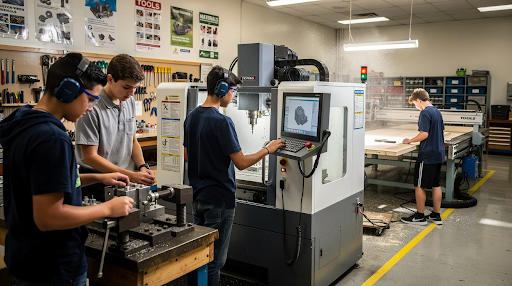
Example Scenario: A high school deploys one PERFORMANCE ATC router and a CO2 laser in a shared lab. Using the ACADEMY curriculum, students progress from basic design to certified operation over a semester—learning joinery, drilling patterns, and material selection in a working production environment.
Lasers and Shop Automation: When to Add Them
While CNC routers remain primary production tools, many shops and schools pair them with CO2 lasers and light automation to expand capability.
CO2 Laser Applications:
- Engraving logos and branding
- Cutting thin wood, acrylic, and leather
- Prototype signage with fine detail
- Explore options at laser machines and accessories
Common Router Accessories:
- Dust collection systems
- Vacuum hold-down for secure material handling
- Rotary attachments for cylindrical work
- Basic material-handling aids for increased throughput
Simply designs systems so users can start with a SIMPLY or DISCOVERY CNC router and later add lasers and automation as production grows—keeping software and workflow consistent.
Example: A small sign shop begins with a single router for panel work. Later, they add a CO2 laser for branding and a rotary for cylindrical products without overhauling their entire process or retraining staff.
Support, Training, and Long-Term Reliability
The support behind any CNC machine for sale matters as much as the specification sheet—especially for first-time users and educational programs.
Simply Technologies Support:
- Direct phone support at 800 288 2961
- Remote and on-site assistance
- Machine selection guidance based on your specific applications
Long-Term Reliability:
- Rigid machine frames built for day-to-day operation
- Proven control systems with modern hardware
- Components selected for small production shops and classrooms
Ongoing Training:
- Refreshers for staff turnover
- Updates to CAD/CAM workflows
- Safety refreshers aligned with school-year cycles
Discuss specific applications (materials, run times, part volumes) so the right series and accessories are configured from the start.
How to Get Started When You See a CNC Machine for Sale
When you encounter a promising listing or browse systems on a vendor site, follow these practical steps.
Buyer Checklist:
- Define applications and materials (wood, plastics, aluminum)
- Estimate part volume and production rhythm
- Confirm available space and power requirements
- Set a realistic budget including total cost of ownership
- Identify training needs and support requirements
Compare at least two sizes or series within Simply’s CNC lineup—such as DISCOVERY versus PERFORMANCE—at Simply Technologies CNC Products before finalizing.
Call 800-288-2961 with a short list of parts or drawings. A technician can recommend table size, spindle power, motor options, and whether ATC is justified for your workflow.
Ready to find your ideal CNC system? Explore CNC and Laser Systems on the Simply Technologies site, or connect with the education team for curriculum-integrated solutions.
FAQ: CNC Machine for Sale
What is the typical lead time for a new CNC router from Simply Technologies?
Standard SIMPLY or DISCOVERY configurations typically ship within several weeks. Customized PERFORMANCE ATC builds require longer schedules depending on specifications. Call 800 288 2961 to confirm current lead times for your configuration.
Do I need prior CNC experience to run a Simply Technologies machine?
No prior experience is required. Simply’s training programs, ACADEMY curriculum, and intuitive control systems are designed for first-time users in schools, maker spaces, and small shops.
Which materials can I process on Simply Technologies CNC routers?
Common materials include plywood, hardwood, MDF, plastics like acrylic and HDPE, and non-ferrous metals such as aluminum. For application-specific questions about steel or specialty materials, discuss your needs with support.
Can I upgrade from a SIMPLY machine to a higher series later?
Yes. The product structure is intentionally scalable. Users can start with SIMPLY or DISCOVERY and move to PERFORMANCE or PERFORMANCE ATC as needs grow, often reusing CAD/CAM workflows and training investments.
How is a CNC router different from a CO2 laser in daily use?
Routers remove material with cutting tools and handle thicker, denser stock—ideal for cabinetry and structural parts. CO2 lasers excel at fine engraving and thin materials. Both are complementary and can be integrated into a single shop or classroom plan.